Your next doctor’s appointment might be with an AI

A new wave of chatbots are replacing physicians and providing frontline medical advice—but are they as good as the real thing?

“My stomach is killing me!”

“I’m sorry to hear that,” says a female voice. “Are you happy to answer a few questions?”

And so the consultation begins. Where’s the pain? How bad is it? Does it come and go? There’s some deliberation before you get an opinion. “This sounds like dyspepsia to me. Dyspepsia is doctor-speak for indigestion.”

This story is part of our November/December 2018 IssueSee the rest of the issue
Subscribe

Doctor-speak, maybe, but it’s not a doctor speaking. The female voice belongs to Babylon, part of a wave of new AI apps designed to relieve your doctor of needless paperwork and office visits—and reduce the time you have to wait for medical advice. If you’re feeling unwell, instead of calling a doctor, you use your phone to chat with an AI.

Recommended for You
  1. Microsoft just booted up the first “DNA drive” for storing data
  2. A quantum experiment suggests there’s no such thing as objective reality
  3. Russia wants to cut itself off from the global internet. Here’s what that really means.
  4. A meteor exploded over Earth with 10 times the energy of Hiroshima’s atomic bomb
  5. A “halo drive” could accelerate interstellar spacecraft to close to the speed of light

The idea is to make seeking advice about a medical condition as simple as Googling your symptoms, but with many more benefits. Unlike self-diagnosis online, these apps lead you through a clinical-grade triage process—they’ll tell you if your symptoms need urgent attention or if you can treat yourself with bed rest and ibuprofen instead. The tech is built on a grab bag of AI techniques: language processing to allow users to describe their symptoms in a casual way, expert systems to mine huge medical databases, machine learning to string together correlations between symptom and condition.

Babylon Health, a London-based digital-first health-care provider, has a mission statement it likes to share in a big, bold font: to put an accessible and affordable health service in the hands of every person on earth. The best way to do this, says the company’s founder, Ali Parsa, is to stop people from needing to see a doctor.

When in doubt, the apps will always recommend seeking a second, human opinion. But by placing themselves between us and medical professionals, they shift the front line of health care. When the Babylon Health app started giving advice on ways to self-treat, half the company’s patients stopped asking for an appointment, realizing they didn’t need one.

Babylon is not the only app of its kind—others include Ada, Your.MD, and Dr. AI. But Babylon is the front-­runner because it’s been integrated with the UK’s National Health Service (NHS), showing how such tech could change the way health services are run and paid for. Last year Babylon started a trial with a hospital trust in London in which calls to the NHS’s non-­emergency 111 advice line are handled partly by Babylon’s AI. Callers are asked if they want to wait for a human to pick up or download the Babylon-powered “NHS Online: 111” app instead.

Around 40,000 people have already opted for the app. Between late January and early October 2017, 40% of those who used the app were directed to self-treatment options rather than a doctor—around three times the proportion of people who spoke to a human operator. But both the AI and the humans staffing the phone line told the same proportion of people to seek emergency care (21%).

When the app started giving advice on ways to self-treat, half of patients stopped asking for an appointment, realizing they didn’t need one.

Now Babylon has also co-launched the UK’s first digital doctor’s practice, called GP at Hand. People in London can register with the service as they would with their local doctor. But instead of waiting for an appointment slot and taking time off work to see a physician in person, patients can either chat with the app or talk to a GP at Hand doctor on a video link. And in many cases the call isn’t needed. The human doctor becomes your last resort rather than your first.
Illustration showing ipad with "I recommend" and a bandage illustration
40,000 people in London have used the Babylon app.

GP at Hand has proved popular; some 50,000 people registered in the first few months, among them Matt Hancock, the UK health minister. Babylon now wants to expand across the UK. The service is also available in Rwanda, where 20% of the adult population has already signed up, according to Mobasher Butt, a doctor and a member of Babylon’s founding team. And it’s setting up services in Canada, with plans to do the same in the US, the Middle East, and China.

Your doctor is overloaded
For 70 years, the NHS has provided free medical care to anyone who needs it, paid for by UK taxpayers. But it is showing signs of strain. Two generations ago there were 50 million Britons, and their average life expectancy was not much over 60 years. There are now 66 million, and most can expect to live into their 80s. That stretches the resources of a system that has never been flush with cash.

On average, people in the UK see a doctor six times a year, twice as often as a decade ago. From 2011 to 2015, the average GP clinic’s patient list grew by 10% and its number of contacts with patients (by phone or in person) grew by 15.4%, according to a survey by the King’s Fund. In a survey by the British Medical Association in 2016, 84% of general practitioners said they found their workload either “unmanageable” or “excessive,” with “a direct impact on the quality” of care they gave their patients.Sign up for the The AlgorithmArtificial intelligence, demystifiedStay updated on MIT Technology Review initiatives and events?

  • Yes
  • No

In turn, people often have to wait days to get a non-urgent consultation. Many show up at hospital emergency departments instead, adding even more strain to the system. “We have the perception that it’s older people who turn up [at the emergency room],” says Lee Dentith, CEO and founder of the Now Healthcare Group, a health-tech company based in Manchester, UK. “But it’s not. It’s the 18- to 35-year-olds who are unwilling to wait a week for an appointment.”

Population and life expectancy will continue to grow. By 2040, it is estimated, the UK will have more than 70 million people, one in four of whom will be over 65. Most other rich countries are also getting older.

At the same time, the next few decades will see more people living with long-term illnesses such as diabetes and heart disease. And better treatment for diseases like cancer means millions more people will be living with or recovering from them.

Of course, the UK is not alone. Whether because of prohibitive costs in the US or the lack of medical professionals in Rwanda, “all health systems around the world are stretched,” says Butt. “There’s not enough clinical resources. There’s not enough money.”

Which is where companies like Babylon come in. A chatbot can act as a gatekeeper to overworked doctors. Freeing up even more of the doctor’s time, the AI can also handle paperwork and prescriptions, and even monitor care at home.

A chatbot can also direct people to the right provider. “A GP is not always the best person to see,” says Naureen Bhatti, a general practitioner in East London. “A nurse might be better at dressing a wound, and a pharmacist might be better for advice about a repeat prescription. Anything that helps unload a very overloaded system, allowing doctors to do what they are best at, is always welcome.”

Sometimes AI is just better
Bhatti remembers how upset lots of doctors were when patients first started bringing in printouts from their own web searches. “How dare they try and diagnose themselves! Don’t think you can negate my six years at medical school with your one hour on the internet.” But she likes to see it from the patients’ perspective: “Well, don’t think you can negate my six years of living with this illness with your one-hour lecture at medical school.”

When a patient does meet a doctor face to face, the AI can still help by suggesting diagnoses and possible treatments. This is useful even when a doctor is highly skilled, says Butt, and it’s “really critical” in poorer countries with a shortage of competent doctors.

AI can also help spot serious conditions early. “By the time most diseases are diagnosed, a £10 problem has become a £1,000 one,” says Parsa. “We wait until we break down before going to a doctor.” Catching a disease early slashes the cost of treating it.

These apps first hit the market as private health services. Now they are starting to integrate with national health-care providers and insurers. For example, Ada users can share their chatbot sessions with their NHS doctor, and the company is now working with a handful of GP practices to enable the chatbot to refer them to the doctor. Another app, Now Patient, provides video consultations with your existing doctor, and it also acts as an AI pharmacist. Users can buy their drugs from the Now Healthcare Group’s drug-­delivery service. It’s a kind of Amazon for medicines.

“How do we make this a job that people want to do? I don’t think … consulting from their kitchen is why people get into medicine. They come to meet patients.”

“This is a service that patients really want, that they didn’t previously have, and that is now being provided to them through the NHS 365 days a year, 24 hours a day, for free,” Butt says of Babylon. “And the brilliant thing is it doesn’t cost the NHS a single penny more to deliver that.”

Not only will the AI in these apps get smarter; it will get to know its users better. “We’re building in the ability for patients to manage their health not only when they’re sick, but also when they’re not sick,” says Butt. The apps will become constant companions for millions of us, advising us and coaxing us through everyday health choices.

Death by chatbot?
Not everyone is happy about all this. For a start, there are safety concerns. Parsa compares what Babylon does with your medical data to what Facebook does with your social activities—amassing information, building links, drawing on what it knows about you to prompt some action. Suggesting you make a new friend won’t kill you if it’s a bad recommendation, but the stakes are a lot higher for a medical app.

According to Babylon, its chatbot can identify medical conditions as well as human doctors do, and give treatment advice that’s safer. In a study posted online in June and coauthored with researchers at Imperial College London, Stanford University, and the Northeastern Medical Group, Babylon put its AI through a version of the final exam of the Royal College of General Practitioners (RCGP), which British GPs must pass in order to practice unsupervised. Babylon’s AI scored 81%, 9% higher than the average grade achieved by UK medical students.

The RCGP was quick to distance itself from Babylon’s hype, however. “The potential of technology to support doctors to deliver the best possible patient care is fantastic, but at the end of the day, computers are computers, and GPs are highly trained medical professionals: the two can’t be compared and the former may support but will never replace the latter,” said RCGP vice chair Martin Marshall in a statement. “No app or algorithm will be able to do what a GP does.”

Illustration of a syringe and colorful liquid
Douglas Heaven is a freelance writer based in London. His most recent story for MIT Technology Review was “Can you spot the cryptocrime in this picture?” in our May/June issue.

Others level far more serious charges, suggesting that Babylon has focused on making its service accessible and affordable at the expense of patients’ safety. One Twitter user with the handle DrMurphy11 (he’s an NHS consultant who told me he needs to remain anonymous because of the corporate culture there) has coined the hashtag #DeathByChatbot. In videos showing interactions with the app, DrMurphy11 suggests that Babylon’s AI misses obvious diagnoses and fails to ask the right questions. “I have no concerns about health tech or AI in general,” he says. “No doctor wants to make mistakes, and any system that helps minimize the risk of harm from human error will be welcomed.” But he’s worried that companies are misleading doctors and the public with marketing claims that vastly oversell their current tech.

Babylon has also met with criticism in Rwanda, where it runs the Babyl service, for not taking local epidemiology into account. In an interview with the BBC, Rwanda’s minister of health claimed that the Babyl app included no questions about malaria, for example (although Babylon disputes this).Sign up for Clocking InA look into how technology is shaping the workplace of the futureStay updated on MIT Technology Review initiatives and events?

  • Yes
  • No

Still, while Babylon may not be as good as a real doctor (and such apps are always careful to recommend you see a real doctor when in doubt), playing it too safe would defeat the purpose. “We wanted to re-create the same pragmatic approach that a clinician takes,” says Butt. “If we just had a group of nonclinical people building the service, they might have gone for something that was 100 percent safe, but that could mean you send everyone to hospital, which is not what a real doctor or nurse would do.”

Another fear is that digital-­first services will create a two-tiered health-care system. For example, GP at Hand advises people with serious medical issues to think twice about signing up to a practice that offers mostly remote access to doctors. That might seem prudent, but it has led to accusations that GP at Hand is effectively cherry-picking younger patients with less complex—and less expensive—health-care needs. Since British GP practices get per-­patient funding from the NHS, cherry-picking would mean the rest of the health-care system is left to do more with less.

For some GPs, this isn’t acceptable. “We take everybody,” says Bhatti. But Oliver Michelson, a spokesperson for the NHS, accepts that GP at Hand has to issue some form of caveat—it can’t realistically welcome everyone. “They are not denying people access but saying that if you’re going to need to come into your GP regularly, a digital-first service may not be the best place to be,” he says.

And Butt insists that they exclude nobody. “The service is available to everyone,” he says; it just may not suit some people, such as those with severe learning difficulties or visual impairments, who would struggle with the app.

People still come in handy
For Bhatti, having a local doctor who knows you is a crucial part of the health system. “Knowing your doctor saves lives,” she says. “Doctors will pick up things because there’s continuity.” She thinks this is just as much an issue for doctors as for patients. “How do we make this a job people want to do?” she says. “I don’t think people working flexibly, consulting from their kitchen, is why people come to medicine. They come to meet patients.”

Not even Butt envisions chatbots replacing human doctors entirely. “Care is not just about diagnosing or prescribing medicine,” he says. “It’s about knowing your patient is going to be able to cope with the chemotherapy you’re proposing for them, knowing that their family will be able to offer them the support that they’re going to need for the next few months. Currently there is no software that’s going to be able to replace that.”

Source: https://www.technologyreview.com/s/612267/your-next-doctors-appointment-might-be-with-an-ai/

Chatbot or Chatbaby? Why Chat Technology Needs Time to Mature

As we lean into 2019, chatbots and digital assistants will continue to play a prominent role in discussions about artificial intelligence (AI) in the workplace.

For many employees, chatbots and other conversational AI tools will be a user-friendly introduction to enterprise search, something businesses have struggled with for decades. However, flawed learning models can inadvertently produce search results that are bogged down by content that doesn’t hold much business value. For example, rather than unearthing critical company documents, these search engines may instead highlight content that has a high engagement level and holds a certain amount of “viral” value — like a shared photo of the holiday party.

The potential for chatbots is in their ability to remove “Where is it?” from the search conversation, and transform it into a “What do you need? I’ll find it” experience.

When users show interest in particular topics, digital assistants can learn their tendencies and alert them when relevant content is being posted. While the prospect of automation is an exciting one, we must keep a realistic perspective on what we can and cannot reasonably expect from digital assistants in the near future. Like anything that sounds really good, the devil is in the details.

Related Article: Want to Use Chatbots and Smart Speakers in Your Workplace? Think Big

Conversational Shortcomings: Where Chat Technology Must Grow Up

In their current state, chatbots are used heavily in customer service and retail operations, helping shoppers get to where they need to be and answering straightforward questions. If you visit a retail site, chances are you’ll be met with a popup dialog box with a message from a friendly assistant asking what it can do for you. But while chatbots offer a number of benefits, they also have some widely known downsides: They get confused easily, they often can’t answer simple questions, and they often provide no more help than what you’d get if you just typed a question into a search box.

Additionally, these automated interactions lack a human element that people so desperately want. A recent study (registration required) from software company Acquia found that 45 percent of consumers in North America, Australia and Europe describe chatbots a “annoying.” Further, a recent PwC study on customer experiencestated that 64 percent of U.S. consumers and 59 percent of all consumers feel companies have lost touch with the human element of customer experience. And 75 percent of global consumers say they would rather deal with a human than a chatbot or other automated systems.

Not being conversational enough is and has been a huge problem for chatbots. The whole purpose of a chatbot is to be able to provide around-the-clock support in a way that makes people feel as though they’re chatting with live human beings. That has yet to be achieved.

If chatbots are still struggling in 2019 to be conversational and effective at small tasks at the customer service and retail levels, imagine the problems they may face at the enterprise level. It’s entirely more complex to map out the detail-oriented conversational language that will help an employee navigate through the weeds of internal systems.

So before you roll out a chat-based system in the digital workplace, it is imperative to master the complex machine learning and language obstacles first.

Plus, even if conversational technology could be deployed easily, tech giants like Google would have made even bigger investments into the digital workplace and collated the output of various applications and their application programming interfaces (API) to showcase it. The fact remains that the amount of data required for a truly conversational and intuitive chatbot experience is far too vast. There is a greater level of machine learning required around language programming and intent that we have not seen, and likely won’t see in 2019.

Related Article: Chatbots Belong in the Workplace (Provided They’re Well-Designed)

An Alternative to Chatbots: Technology That’s Mature Enough for Today’s Digital Workplace

As noted earlier, a goal for these assistants is to be able to proactively help employees streamline the way they connect with the people, tools and information they need. They can already assist with small-scale tasks, but there is little proof that they can be effective at handling more complex tasks.

The solution to this is to build upon and make the most of the tools you likely have on hand already. Rather than having to ask a clunky chatbot for help, workers should be able to easily access what they need from a centralized location. Hubs like employee intranets allow companies to have information readily available at employees’ fingertips — all they have to do is search. Beyond their ability to store information in an easily-accessible way, intranets also allow you to instantly connect with the people, tools and other systems that you need. They are true collaboration and support systems.

This goes hand in hand with companies needing to expand their mobile-ready approaches. As the workforce gets younger with the infusion of tech-savvy millennials and Gen Z workers, companies need to expand their mobile strategies. Remote working is growing at the fastest rate we’ve seen, so it’s important for employees to be able to access what they need on the go.

Implementing social media features into your communication channels will also help connect remote employees to one another by enabling a more human element when they go looking for a resource. Younger workers grew up on social media, so this functionality will feel familiar to them, and the tools will be easy for them to adopt. Features like the ability to comment and share allow employees to exchange information and resources freely — and between actual humans instead of via bots!

Related Article: The Enterprise Chatbot: Your Future Coworker?

Growing Pains

Chatbots will someday be put to meaningful use in enterprise settings, likely helping with search and assisting on day-to-day projects. But they currently face too many hurdles to be effective. As is the case with any evolving technology, there will be growing pains that need to be worked out before chatbots become widely adopted.

As you look to invest more in this technology in the coming months and years, be sure to roll out chatbots in environments where content, tools and resources are up to date, relevant and easy to find, so that the chatbots can better aid employees in finding what they need. Chatbots will never solve enterprise search problems if they’re built on cracked foundations.

Rather than viewing 2019 as the year chatbots will become fully developed and functional, it’s better to think of 2019 as the year they continue to improve so that they can one day become an integral part of any digital workplace.

Source: https://www.cmswire.com/digital-workplace/chatbot-or-chatbaby-why-chat-technology-needs-time-to-mature/

“Types of Chatbots and How They Help Businesses”

HOMEBLOGBUSINESSShare this article

Content

Chatbots can talk to your customers for you. In this lies their ability to handle various aspects of customer relations, substituting a number of employees with a single bot.

In this article, we look at the essence of chatbots: how and where they work, which industries can benefit from them, and where they’ve already been successful.

Finding the best platform for your chatbot

There are two types of chatbots – those built into messengers (Slack, Telegram, Discord, Kik, etc.) and standalone applications. We advise building a chatbot in a messenger first because there are a lot of people using them already, so your service will be able to receive the recognition it deserves. Just look at these statistics from April 2018 showing the number of monthly messenger users.

Source: Statista.com

In the top positions are, of course, WhatsApp and Facebook Messenger, with 1.5 and 1.3 billion monthly users respectively. In third position is the Chinese messenger WeChat, which has an average of 1 billion users a month. QQ Mobile, Skype, Viber, Snapchat, LINE, and Telegram constitute the rest of the list, each having fewer than 1 billion monthly users – yet still substantial audiences.

To choose the perfect platform for your bot, research the most popular messengers in your area. Alternatively, you could go for a multi-platform chatbot, supporting a number of messenger applications at once.

Now let’s understand how chatbots work

There are two main ways in which a chatbot can be built – with and without machine learning.

Chatbots that learn

Chatbots that use machine learning are chatbots that can learn and become better over time. The technology here isn’t half as complicated as you might think, even though it does appear quite sci-fi at first glance.

What’s particular about machine learning-powered chatbots is that they can understand natural speech. Unlike their scripted counterparts (which we’re going to discuss in just a bit), machine-intelligent chatbots can understand questions and commands the way real people phrase them, as opposed to only understanding a set of predefined commands.

This is beneficial if you’re looking to offer a human-like experience.

Let’s look at Mitsuku, for example:

Source: Mitsuku on KiK

Mitsuku is a three-time winner of the Loebner Prize (the chatbot equivalent of the Turing test). Created by Steve Worswick from Artificial Intelligence Markup Language (AIML), the bot is available on Facebook Messenger, KiK, Telegram, Skype, and Twitch, featuring also an original web version and an Android application (currently in beta).

Mitsuku isn’t an assistant who performs tasks to make your life more comfortable. She’s a friend, a partner in conversation, and an interesting way to spend your time. Mitsuku can tell jokes, ask questions about religion and philosophy, and answer whatever questions you might have for her (if they aren’t “Can you do this for me?”).

Chatbots that don’t learn

Scripted chatbots tend to be a business’s go-to choice. They specialize in responding to specific commands and answering specifically phrased questions.

A scripted chatbot has a set of questions it can respond to with a corresponding set of answers. This means each conversation can only follow a number of defined paths. It’s often the case that users don’t even type anything in, instead selecting from a list of questions and commands that the bot understands.

The H&M bot on KiK is a great example of a scripted chatbot. When you first log in, it asks a series of questions to understand your style preferences. Then it offers three options:

  • Build an outfit by selecting pieces of clothing and accessories from H&M’s catalog to create a look. The bot then returns that look as an image.
  • Vote on outfits created by other bot users to choose the best.
  • Search outfits by accessory or item of clothing (e.g. “black shirt”) to view user-generated outfits that include it.

Source: H&M bot on KiK

The chatbot is limited in what it can say and do. But if you think about it, users won’t come to the H&M bot for life advice or to discuss their favorite novel. They want to look at clothes, check out new items, put together some outfits, and then come to the store in person to purchase the stuff they’ve already seen and liked.

The H&M bot does what it’s supposed to: it involves people into the H&M brand, creates an element of interactive communication, and effectively upsells customers.

The benefits of chatbots

Depending on what task you want a chatbot to complete, you’ll find different results. There are, however, some universal benefits that a chatbot can bring to any business regardless of its primary focus.

E-commerce and online marketing

There are many ways in which the e-commerce industry has benefited from chatbot technology. When your goal is to sell products and services, the ability to communicate directly with customers is crucial.

We’ve already mentioned the H&M chatbot, but you may have heard about other examples from Sephora, eBay, 1-800-Flowers, and other companies. These chatbots have managed to substantially increase company revenues over a short period of time. Not only that, but there are many other ways that chatbots can help e-commerce businesses:

  • Substituting for emails – Instead of composing hundreds of cold emails, you can simply have a chatbot talk with your customers.
  • Managing sales funnels – Through chatting, bots can determine which customers belong to which sales funnels. This helps your business choose the best approaches to convert them.
  • Adding interactivity – Just like in the H&M example, bots can offer an element of interaction to the products and services you’re selling. This can help users feel as if they already know your selection, making them more eager to buy things they’ve already seen and liked.
  • Building customer relationships on a more personal level – It’s possible to add some personality to chatbots. This can turn the process of chatting with them into a real, almost human conversation, potentially making customers enjoy your brand more.
  • Solving the abandoned cart issue – Customers often add products to the cart and never end up buying them. Before chatbots, marketers would send emails to remind users about their carts, but the process has changed since chatbot technology has been introduced. Now it’s enough for a bot to text your customers with a “Hey, you cart’s still waiting for you!” as a friendly reminder.

Travel, hospitality, and tourism

Chatbots can do a great deal for the travel, hospitality and tourism industries. They offer 24/7 access to data, allowing customers to book trips and rooms instantly and on the go. And using chatbots is cheaper for businesses, too! Employees don’t need to answer calls and repeat the same stuff over and over; customers can just text their requirements to a chatbot.

Chatbots are already working for Marriott, KLM Royal Dutch Airlines, Wynn Las Vegas, and Waylo. With chatbot technology, companies can benefit in many ways:

  • Engage audiences – Once customers ask a chatbot about something, it can analyze what they’ve written to produce personalized content. When asking for a plane ticket to Los Angeles, for instance, users can receive information about room availability in partnering hotels, learn about the best nearby restaurants, and so on. With the ability to learn so many useful things at once, customers are likely to continue returning to the chatbot again and again.
  • Anticipate user needs – After learning enough about a particular customer, an intelligent chatbot can offer services based on their previous requests. If a user has been travelling to Chicago once a month for a year, the bot might offer them information on room availability a couple days in advance of their usual travel date.
  • Give recommendations on nearby locations – Let your chatbot know about cafes and restaurants near your hotel or airport, and users will very much enjoy asking it where to have coffee or brunch. For airports, users could ask about services and facilities.
  • Offer automated services – A bot inside a hotel could let users order meals or room service without having to call anyone.
  • 24/7 customer service – Whenever users have a question or concern about a hotel or transportation, a customer service chatbot can answer them. If the technology is unable to present relevant information, a customer can simply be redirected to a real person.

Case study: Social Media Platform for Sharing Your Favorite Travel Experiences

Healthcare

When it comes to healthcare, nothing substitutes a real professional. However, there are some cases in which chatbot technology could be a real lifesaver by promoting healthy living and helping patients figure out a number of important questions. Chatbots could guide users through emergencies, giving them step-by-step CPR instructions or explaining how to help someone with diabetes, and perform many other tasks:

  • Support self-care and self-monitoring – A chatbot doesn’t necessarily have to answer questions and share information. It can help patients track their health and fitness. For instance, a patient could take their body measurements (blood pressure, weight, pulse, blood sugar level, etc.), give them to a chatbot, and then see a comprehensive analysis of their data over time. If some measurement is far off, the chatbot could show concern and offer to schedule a doctor’s appointment. 

    What chatbots can also be great for is setting reminders to take medication, add health data, exercise, drink water, and so on.
  • Offer reliable medical information – Googling symptoms of a hypothetical disease is something of a joke now. However, if a chatbot is connected to a number of reliable medical databases, it could be able to give patients relevant medical advice and offer ways of understanding their conditions.
  • Get important information from new patients – You know those long questionnaires that you need to fill out whenever you come to a new doctor’s office? Answering these questions would be many times simpler with a chatbot that could request, record, and then analyze important patient information.

Read more: How to Build an Effective Medical Mobile App

  • Perform automated appointment follow-ups – It’s important to check in with a patient sometime after an appointment. A chatbot can do that by asking people about how they feel and figuring out whether they need another appointment.

    This also works well for postoperative care. A chatbot could then serve as a pocket nurse, reminding about medications, explaining some things patients might be experiencing, and scheduling doctor’s appointments if necessary.
  • Show electronic healthcare records. Being more of an internal hospital tool, this feature could allow doctors to quickly receive information about patients by simply typing in a patient ID number.

Case study: Developing a Mobile Healthcare App for Doctor-Patient Consultations

On-demand services

Imagine describing your perfect pizza in a text message and then having it appear on your doorstep. This is exactly the sort of feature a chatbot can provide for on-demand services. Just look at how Pizza Hut did it with their Facebook Messenger and Twitter chatbot.

Source: Pizza Hut bot on Facebook Messenger

Pizza Hut’s technology allows customers to place orders with a single touch of a finger. It can answer frequently asked questions and present information about the latest promotions. Because the bot is so easy to access and doesn’t need to be installed separately, users don’t feel any pressure talking to it, which results in higher retention rates and easier ordering.

Read more: How to Build a Food Delivery App for a Restaurant

Banking and finance

A great number of global banks have already integrated chatbots with their services: American Express, PayPal, Bank of America, Mastercard, Visa, and others. You might have used some of their financial assistants yourself – such as Eno, HiCharlie, or Trim. Among the features that financial facilities could implement with chatbots are:

  • Account alerts and notifications – A chatbot could let you know whenever unusual activity happens on your account to determine whether it’s you. It could also remind about fees, upcoming charges, and so on.
  • Tips and suggestions on financial management – A chatbot could help users figure out the most efficient ways of spending money based on their past expenses. For instance, it could monitor subscriptions and then point out ones that they no longer use so that they can stop paying for them.
  • Customer service – Chatbots could answer customers’ burning questions around the clock, always being friendly and informative no matter what they’re asked or when they’re asked it.
  • Help with enterprise resource management – Chatbots could also help automate repetitive internal bank processes.

Read more: How To Maximize the Success of Business Process Automation

Customer service

Last but not least, we come to customer service – the area where chatbots have probably done the most good. It’s just so convenient to have a digital assistant that can answer customer questions in as much detail as necessary. Chatbot-based customer service can be applied to any industry, accomplishing two main tasks:

  • Automating frequently asked questions – It’s often the case that customers want answers to the same questions but don’t want to read the FAQ page. Answering common questions isn’t an efficient way for your employees to spend their time, however, and having a chatbot answer them could be a much better solution.
  • Differentiating between questions the chatbot can answer and questions that should be referred to a real person – However smart they might be, chatbots can’t always fully substitute for real people. A chatbot could look at the question it’s being asked, grade it based on its competence to answer, and then refer the more complex issues to a human assistant.

Develop a chatbot with SteelKiwi

Do you feel inspired by the numerous benefits of chatbot technology? If so, we strongly encourage you to contact our sales representatives to start discussing your product today.

You’re also welcome to look through our SteelKiwi projects page to learn about the awesome products we’ve created so far.

HOMEBLOGBUSINESSShare this article

Content

Chatbots can talk to your customers for you. In this lies their ability to handle various aspects of customer relations, substituting a number of employees with a single bot.

In this article, we look at the essence of chatbots: how and where they work, which industries can benefit from them, and where they’ve already been successful.

Finding the best platform for your chatbot

There are two types of chatbots – those built into messengers (Slack, Telegram, Discord, Kik, etc.) and standalone applications. We advise building a chatbot in a messenger first because there are a lot of people using them already, so your service will be able to receive the recognition it deserves. Just look at these statistics from April 2018 showing the number of monthly messenger users.

Source: Statista.com

In the top positions are, of course, WhatsApp and Facebook Messenger, with 1.5 and 1.3 billion monthly users respectively. In third position is the Chinese messenger WeChat, which has an average of 1 billion users a month. QQ Mobile, Skype, Viber, Snapchat, LINE, and Telegram constitute the rest of the list, each having fewer than 1 billion monthly users – yet still substantial audiences.

To choose the perfect platform for your bot, research the most popular messengers in your area. Alternatively, you could go for a multi-platform chatbot, supporting a number of messenger applications at once.

Now let’s understand how chatbots work

There are two main ways in which a chatbot can be built – with and without machine learning.

Chatbots that learn

Chatbots that use machine learning are chatbots that can learn and become better over time. The technology here isn’t half as complicated as you might think, even though it does appear quite sci-fi at first glance.

What’s particular about machine learning-powered chatbots is that they can understand natural speech. Unlike their scripted counterparts (which we’re going to discuss in just a bit), machine-intelligent chatbots can understand questions and commands the way real people phrase them, as opposed to only understanding a set of predefined commands.

This is beneficial if you’re looking to offer a human-like experience.

Let’s look at Mitsuku, for example:

Source: Mitsuku on KiK

Mitsuku is a three-time winner of the Loebner Prize (the chatbot equivalent of the Turing test). Created by Steve Worswick from Artificial Intelligence Markup Language (AIML), the bot is available on Facebook Messenger, KiK, Telegram, Skype, and Twitch, featuring also an original web version and an Android application (currently in beta).

Mitsuku isn’t an assistant who performs tasks to make your life more comfortable. She’s a friend, a partner in conversation, and an interesting way to spend your time. Mitsuku can tell jokes, ask questions about religion and philosophy, and answer whatever questions you might have for her (if they aren’t “Can you do this for me?”).

Chatbots that don’t learn

Scripted chatbots tend to be a business’s go-to choice. They specialize in responding to specific commands and answering specifically phrased questions.

A scripted chatbot has a set of questions it can respond to with a corresponding set of answers. This means each conversation can only follow a number of defined paths. It’s often the case that users don’t even type anything in, instead selecting from a list of questions and commands that the bot understands.

The H&M bot on KiK is a great example of a scripted chatbot. When you first log in, it asks a series of questions to understand your style preferences. Then it offers three options:

  • Build an outfit by selecting pieces of clothing and accessories from H&M’s catalog to create a look. The bot then returns that look as an image.
  • Vote on outfits created by other bot users to choose the best.
  • Search outfits by accessory or item of clothing (e.g. “black shirt”) to view user-generated outfits that include it.

Source: H&M bot on KiK

The chatbot is limited in what it can say and do. But if you think about it, users won’t come to the H&M bot for life advice or to discuss their favorite novel. They want to look at clothes, check out new items, put together some outfits, and then come to the store in person to purchase the stuff they’ve already seen and liked.

The H&M bot does what it’s supposed to: it involves people into the H&M brand, creates an element of interactive communication, and effectively upsells customers.

The benefits of chatbots

Depending on what task you want a chatbot to complete, you’ll find different results. There are, however, some universal benefits that a chatbot can bring to any business regardless of its primary focus.

E-commerce and online marketing

There are many ways in which the e-commerce industry has benefited from chatbot technology. When your goal is to sell products and services, the ability to communicate directly with customers is crucial.

We’ve already mentioned the H&M chatbot, but you may have heard about other examples from Sephora, eBay, 1-800-Flowers, and other companies. These chatbots have managed to substantially increase company revenues over a short period of time. Not only that, but there are many other ways that chatbots can help e-commerce businesses:

  • Substituting for emails – Instead of composing hundreds of cold emails, you can simply have a chatbot talk with your customers.
  • Managing sales funnels – Through chatting, bots can determine which customers belong to which sales funnels. This helps your business choose the best approaches to convert them.
  • Adding interactivity – Just like in the H&M example, bots can offer an element of interaction to the products and services you’re selling. This can help users feel as if they already know your selection, making them more eager to buy things they’ve already seen and liked.
  • Building customer relationships on a more personal level – It’s possible to add some personality to chatbots. This can turn the process of chatting with them into a real, almost human conversation, potentially making customers enjoy your brand more.
  • Solving the abandoned cart issue – Customers often add products to the cart and never end up buying them. Before chatbots, marketers would send emails to remind users about their carts, but the process has changed since chatbot technology has been introduced. Now it’s enough for a bot to text your customers with a “Hey, you cart’s still waiting for you!” as a friendly reminder.

Travel, hospitality, and tourism

Chatbots can do a great deal for the travel, hospitality and tourism industries. They offer 24/7 access to data, allowing customers to book trips and rooms instantly and on the go. And using chatbots is cheaper for businesses, too! Employees don’t need to answer calls and repeat the same stuff over and over; customers can just text their requirements to a chatbot.

Chatbots are already working for Marriott, KLM Royal Dutch Airlines, Wynn Las Vegas, and Waylo. With chatbot technology, companies can benefit in many ways:

  • Engage audiences – Once customers ask a chatbot about something, it can analyze what they’ve written to produce personalized content. When asking for a plane ticket to Los Angeles, for instance, users can receive information about room availability in partnering hotels, learn about the best nearby restaurants, and so on. With the ability to learn so many useful things at once, customers are likely to continue returning to the chatbot again and again.
  • Anticipate user needs – After learning enough about a particular customer, an intelligent chatbot can offer services based on their previous requests. If a user has been travelling to Chicago once a month for a year, the bot might offer them information on room availability a couple days in advance of their usual travel date.
  • Give recommendations on nearby locations – Let your chatbot know about cafes and restaurants near your hotel or airport, and users will very much enjoy asking it where to have coffee or brunch. For airports, users could ask about services and facilities.
  • Offer automated services – A bot inside a hotel could let users order meals or room service without having to call anyone.
  • 24/7 customer service – Whenever users have a question or concern about a hotel or transportation, a customer service chatbot can answer them. If the technology is unable to present relevant information, a customer can simply be redirected to a real person.

Case study: Social Media Platform for Sharing Your Favorite Travel Experiences

Healthcare

When it comes to healthcare, nothing substitutes a real professional. However, there are some cases in which chatbot technology could be a real lifesaver by promoting healthy living and helping patients figure out a number of important questions. Chatbots could guide users through emergencies, giving them step-by-step CPR instructions or explaining how to help someone with diabetes, and perform many other tasks:

  • Support self-care and self-monitoring – A chatbot doesn’t necessarily have to answer questions and share information. It can help patients track their health and fitness. For instance, a patient could take their body measurements (blood pressure, weight, pulse, blood sugar level, etc.), give them to a chatbot, and then see a comprehensive analysis of their data over time. If some measurement is far off, the chatbot could show concern and offer to schedule a doctor’s appointment. 

    What chatbots can also be great for is setting reminders to take medication, add health data, exercise, drink water, and so on.
  • Offer reliable medical information – Googling symptoms of a hypothetical disease is something of a joke now. However, if a chatbot is connected to a number of reliable medical databases, it could be able to give patients relevant medical advice and offer ways of understanding their conditions.
  • Get important information from new patients – You know those long questionnaires that you need to fill out whenever you come to a new doctor’s office? Answering these questions would be many times simpler with a chatbot that could request, record, and then analyze important patient information.

Read more: How to Build an Effective Medical Mobile App

  • Perform automated appointment follow-ups – It’s important to check in with a patient sometime after an appointment. A chatbot can do that by asking people about how they feel and figuring out whether they need another appointment.

    This also works well for postoperative care. A chatbot could then serve as a pocket nurse, reminding about medications, explaining some things patients might be experiencing, and scheduling doctor’s appointments if necessary.
  • Show electronic healthcare records. Being more of an internal hospital tool, this feature could allow doctors to quickly receive information about patients by simply typing in a patient ID number.

Case study: Developing a Mobile Healthcare App for Doctor-Patient Consultations

On-demand services

Imagine describing your perfect pizza in a text message and then having it appear on your doorstep. This is exactly the sort of feature a chatbot can provide for on-demand services. Just look at how Pizza Hut did it with their Facebook Messenger and Twitter chatbot.

Source: Pizza Hut bot on Facebook Messenger

Pizza Hut’s technology allows customers to place orders with a single touch of a finger. It can answer frequently asked questions and present information about the latest promotions. Because the bot is so easy to access and doesn’t need to be installed separately, users don’t feel any pressure talking to it, which results in higher retention rates and easier ordering.

Read more: How to Build a Food Delivery App for a Restaurant

Banking and finance

A great number of global banks have already integrated chatbots with their services: American Express, PayPal, Bank of America, Mastercard, Visa, and others. You might have used some of their financial assistants yourself – such as Eno, HiCharlie, or Trim. Among the features that financial facilities could implement with chatbots are:

  • Account alerts and notifications – A chatbot could let you know whenever unusual activity happens on your account to determine whether it’s you. It could also remind about fees, upcoming charges, and so on.
  • Tips and suggestions on financial management – A chatbot could help users figure out the most efficient ways of spending money based on their past expenses. For instance, it could monitor subscriptions and then point out ones that they no longer use so that they can stop paying for them.
  • Customer service – Chatbots could answer customers’ burning questions around the clock, always being friendly and informative no matter what they’re asked or when they’re asked it.
  • Help with enterprise resource management – Chatbots could also help automate repetitive internal bank processes.

Read more: How To Maximize the Success of Business Process Automation

Customer service

Last but not least, we come to customer service – the area where chatbots have probably done the most good. It’s just so convenient to have a digital assistant that can answer customer questions in as much detail as necessary. Chatbot-based customer service can be applied to any industry, accomplishing two main tasks:

  • Automating frequently asked questions – It’s often the case that customers want answers to the same questions but don’t want to read the FAQ page. Answering common questions isn’t an efficient way for your employees to spend their time, however, and having a chatbot answer them could be a much better solution.
  • Differentiating between questions the chatbot can answer and questions that should be referred to a real person – However smart they might be, chatbots can’t always fully substitute for real people. A chatbot could look at the question it’s being asked, grade it based on its competence to answer, and then refer the more complex issues to a human assistant.

Develop a chatbot with SteelKiwi

Do you feel inspired by the numerous benefits of chatbot technology? If so, we strongly encourage you to contact our sales representatives to start discussing your product today.

You’re also welcome to look through our SteelKiwi projects page to learn about the awesome products we’ve created so far.

Source: https://steelkiwi.com/blog/types-of-chatbots-and-how-they-help-businesses/

Facebook Chatbots in 2019 (+5 Messenger Bot Examples)

acebook may be for social connections between families and friends, but its Messenger platform is home to over 300,000 customer service, marketing, and sales chatbots – and this number isn’t slowing down anytime soon.

What we’ll cover:
1. What is a Chatbot?
2. Facebook Chatbot Overview
3. Facebook Chatbot Examples
4. How to Build a Facebook Messenger Chatbot
5. Facebook Chatbot Best Practices

But what exactly is a chatbot?

How does one even operate?

Chatbot Definition

A chatbot is a piece of software that is either pre-programmed or powered by AI to hold conversations with human users. These interactions are often text-based, but through conversational interfaces, they can occur vocally as well.

What does this mean for Facebook marketing and business strategies moving forward?

David Marcus, VP of Messaging Products at Facebook, announced the sharp rise of Messenger chatbots during a keynote presentation at F8 2018. He also stated more than 8 billion messages have been exchanged between Facebook users and businesses that are utilizing chatbots.

Facebook believes these automated messages could help businesses immensely as we move forward in this digital age. Here are some numbers to back up this claim:

  • With a 73 percent satisfaction rate, live chat software has emerged as the top way for customers to interact with businesses.
  • Automation isn’t going anywhere. Up to 85 percent of all customer-business interactions will take place without a human intermediary by 2020.
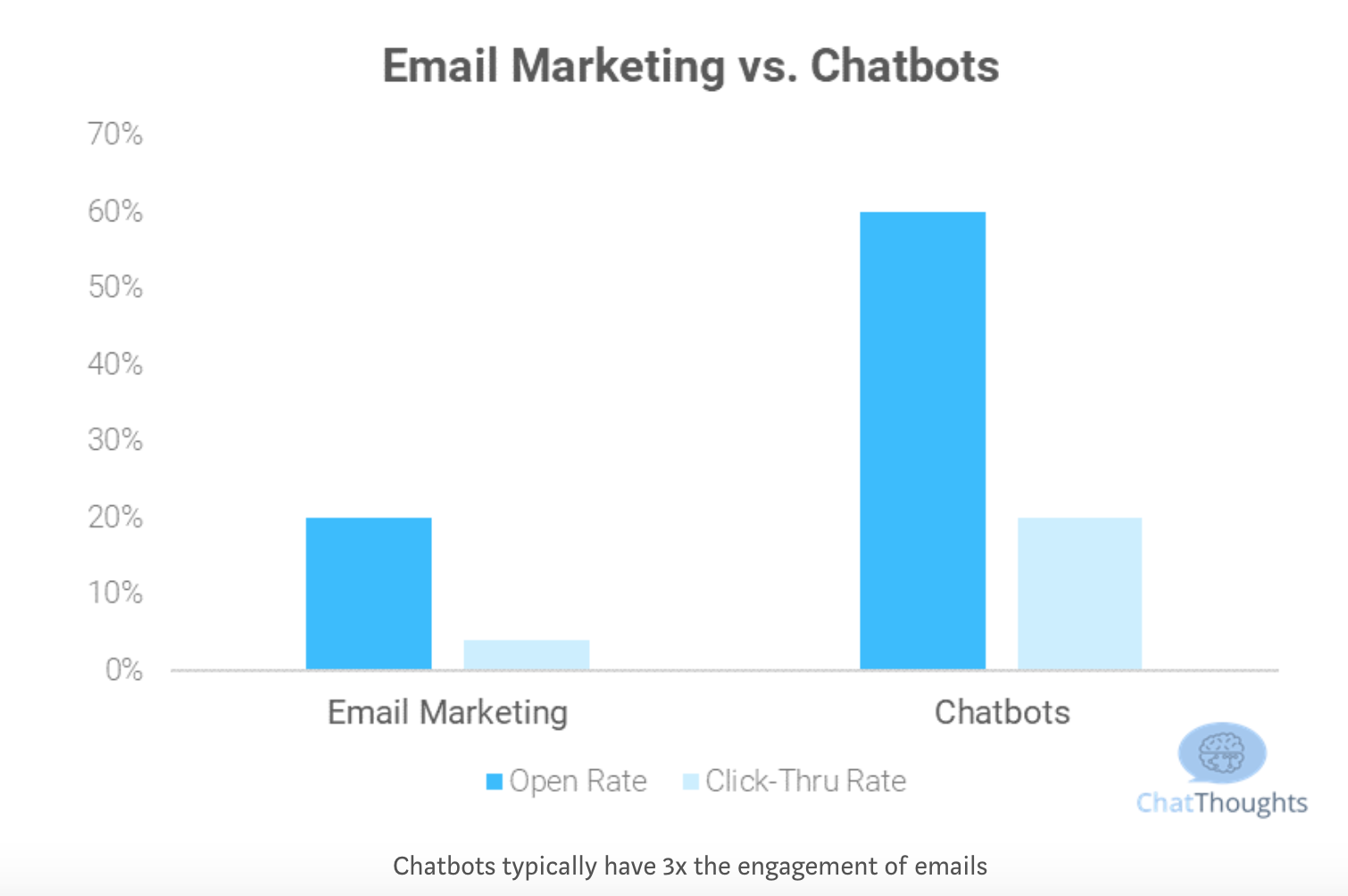
  • In an experiment by HubSpot, content delivered through Facebook Messenger had an open rate of 80 percent and a click rate of 13 percent. The same content delivered through email had an open rate of 33 percent and a click rate of 2.1 percent. In other words, email was completely outclassed by Messenger.

While 300,000 chatbots sound like a lot, it actually equates to less than 1 percent of businesses on Facebook taking advantage of the technology.

If the numbers above indicate anything, it’s that more businesses should look toward Messenger and its chatbot capabilities to bolster their social media marketing strategies and stay competitive in the near future. That’s why we’ve compiled a full guide on why you should consider getting your Facebook chatbot up-and-running.

What is a Chatbot

Does anyone here remember when Cleverbot launched in 1997? I may have been young at the time, but I remember spending hours asking Cleverbot pointless questions and getting less-than-optimal answers.

facebook-chatbots

These interactions, however, weren’t for nothing. Because Cleverbot is powered by artificial intelligence (AI) and not pre-programmed, it is constantly learning how humans interact and the ways we frame our questions.

Since 1997, Cleverbot has learned from nearly 300 million interactions with humans. Little did we know that going down the endless Cleverbot rabbit hole would help pave the way for future chatbots – ones that would be much more valuable to businesses.

We may not be fully aware of it, but many of us hold conversations with chatbots just about every week. Some of today’s most widely-used chatbots include Amazon’s Alexa, Google’s Assistant, and Apple’s Siri. I’m guessing a few of these sound familiar.

The use of digital assistants is on the rise and more people are taking to chatbots as a first point-of-contact with businesses. While chatbots have traditionally supported customer service departments, more businesses are now using them to automate marketing and sales efforts. For a simple entry point into the chatbot world, look no further than Facebook Messenger.

Facebook Chatbots

Amongst all mobile chat apps, Facebook Messenger ranks second with about 1.3 billion monthly active users worldwide. Facebook, however, still remains as the most popular social media network, with 79 percent of U.S. adults obtaining a profile, making Facebook marketing a goldmine for social media marketing teams.

This means if you have a Facebook business page (you should really create one if you haven’t already), there’s a good chance a user will engage with your chatbot to learn more about your business.

Benefits of Facebook Chatbot Marketing

If you’re still not swayed to use Messenger as the platform for your first chatbot, take a look at the top five advantages:

24/7 customer service

Facebook chatbots are live at all hours of the day and send near-instant responses to user inquiries. Even if a chatbots sole purpose is to answer FAQs, it still frees up valuable time for your customer service staff.

Since Facebook actually grades businesses on how responsive they are to messages, users will feel confident that their questions will be answered in a timely manner. Besides, you don’t want a potential customer lingering, do you?

facebook-messenger-chatbot

Automated e-commerce

On the note of potential customers, Facebook chatbots are great for engaging with those who have discovered you via Facebook and are ready to purchase something from your e-commerce business.

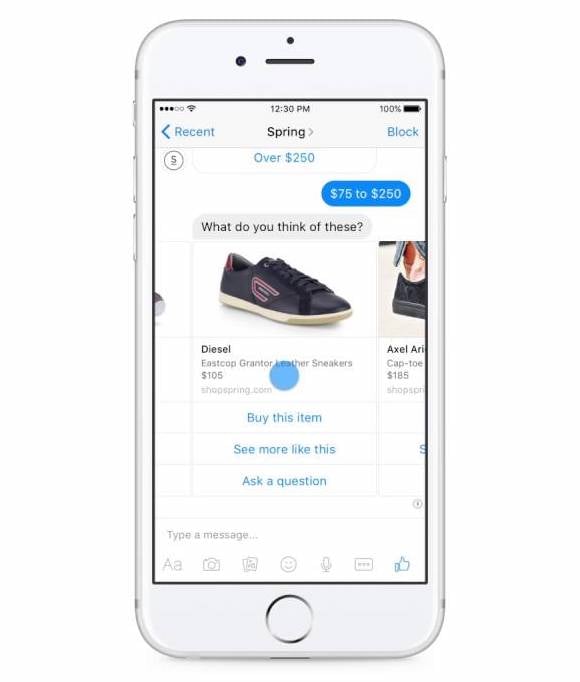
With e-commerce software capabilities, your Facebook chatbot can identify which item the customer is looking for and connect them to that item via social media call-to-action(CTA) buttons in a matter of seconds.

facebook-messenger-marketing

A recent study by DigitasLBi revealed that 37 percent of U.S. adults are willing to make a purchase via chatbots – with the average purchase totaling $55. Clear CTAs and a seamless checkout cart will boost customer confidence when making a purchase.

Targeted leads

Leads are an important part of any marketing strategy, especially when it comes to B2B marketing.

Any of your current followers or users who have engaged with your business page at some point are now part of your subscriber list on Facebook.

What does this mean for your business? Well, both current customers and customers in your scope can be targeted via Messenger for relevant offers, coupon codes, blog content, and more.

Facebook chatbots are the deliverers of these messages. Since customers are much more likely to open a Facebook message compared to email, you can expect higher engagement rates.

Data and analytics

One of the advantages of utilizing a Facebook chatbot is its ability to retain tons of data from customer conversations. When this data is put into action, it can lead to more targeted social media and omnichannel marketing strategies.

facebook-chatbot-analytics

Facebook Analytics is a good starting point for visualizing the activity of your Messenger bot. You can see how many total users are engaging with the bot, the demographics of these users, and the retention rate.

There are other analytic tools, however, that provide more in-depth insight to your chatbots’ performance. Some of these tools unveil who the most engaged users are what drives them to continually use your chatbot. Other tools show which messages have the highest conversion rates.

Personalized chat experiences

People are more open to using chatbots now than ever – and this isn’t just because of the added efficiency. Some of the top-performing Facebook chatbots today provide a personalized, branded experience to its users. For some inspiration on how to provide a similar experience, we’ve listed some of these chatbots below.

Facebook Chatbot Examples

While all Facebook chatbots are implemented with the purpose to increase efficiency, some are doing their jobs better than others. Here are 5 brands utilizing chatbots to drive the efforts of marketing, sales, or customer service:

1. Whole Foods

Jeff Jenkins, Whole Foods’ Global Executive of Digital Strategy and Marketing, stated that were are living in the “expectation economy,” and that consumers would like to be equipped with relevant content by brands they follow. This sentiment served as the basis of Whole Foods’ Facebook chatbot, which launched in 2016.

whole-foods-chatbot

The main purpose of this chatbot is to connect Whole Foods followers with unique recipes. The chatbot takes in a variety of information about the user, such as dietary restrictions and protein preferences. After a recipe is selected, the user can either go with it or opt out for a new one.

Some other neat features of the Whole Foods’ chatbot include processing emojis, linking up to customer rewards, saving recipes for later, and allowing users to signup and receive coupons.

2. Sephora

One of the top cosmetic brands in the world found a new way to serve customers and increase engagement through its easy-to-use Facebook chatbot.

sephora-chatbot

Labeled the Sephora Assistant, this chatbot gained in popularity after Sephora ran a targeted Facebook campaign for U.S. women ages 18-49. When the ad was clicked, the bot would open in Messenger and guide users through a three-step scheduling feature.

The results? An 11 percent higher booking rate of in-store makeup appointments. By utilizing a user’s GPS location to connect them with the nearest store, the booking sequence was also reduced by five steps. Now the chatbot is considered one of Facebook’s top performers.

3. Wall Street Journal

Having to hop on Google to find the latest, most relevant news to your liking can be time-consuming. The Wall Street Journal decided a Facebook chatbot that curated news for its users would be the best way to counter this issue.

WSJ-chatbot

Through clear CTAs, users can customize which content is fed to them through the chatbot. The longer the user engages with the chatbot, the more tailored their newsfeed will be. This is the power of AI.

4. Pizza Hut

Let’s face it, our smartphones are full of applications that rarely get used on a regular basis. If you’re adverse to downloading yet another app just to order a pizza, you can jump on Facebook Messenger and place your next order through Pizza Hut’s chatbot.

pizza-hut-chatbot

In similar fashion to Sephora’s chatbot, Pizza Hut has reduced the amount of steps needed to finalize an order. Fewer steps equal faster delivery, which also equals more time to consume however much pizza your heart desires.

Pizza Hut’s chatbot collects transaction data for an even faster checkout experience your next time through. It also uses this data to suggest new items or promotions – providing franchisees with up-sell opportunities.

5. Mastercard

Mastercard, one of the leading financial service providers, recognized the widespread adoption of chatbots and decided to implement its own on Facebook Messenger for both banks and merchants.

mastercard-chatbot

By utilizing natural language processing software, which dissects human language in a more sensible way for machines, the Mastercard chatbot has a robust set of features.

For merchants, Mastercard has enabled customers with the Masterpass payment service to conduct transactions through the chatbot. This is great news for merchants that haven’t built their own chatbots but would like the added efficiency of one.

Mastercard has also empowered customers to communicate with their banks via the chatbot. For example, users can check their bank accounts, purchase history, and even ask the chatbot to monitor spending habits. This is a great example of a chatbot that provides value to both users and businesses.

How to Build a Facebook Messenger Bot

There is, of course, the looming question of “how much is this going to cost me?” Fortunately, Facebook chatbots are actually free to build and implement, however, it does require some technical skills.

Depending on the complexity of your chatbot and the type of conversations its expected to have, you may need to seek external help developing it. For example, a chatbot with pre-programmed responses could be developed quickly, while a chatbot that utilizes natural language processing may take longer.

For a more in-depth explanation on how to build your Facebook chatbot, check out Facebook’s quick start guide for developers.

Facebook Chatbot Best Practices

Whether you’re just releasing your Facebook chatbot, or figuring out ways a chatbot will be valuable to your business, here are four universal best practices for getting the most out of this technology.

Data transparency

As mentioned before, chatbots collect a variety of data on each user that engages with one. In the age of GDPR and with so much concern around personal data protection, it’s worth being upfront with your customers.

data-transparency

While it’s difficult to give users complete control over which data they share, you could provide a few ways for them to opt in or opt out. The example above prompts the user to check out a privacy agreement and asks for permission before storing the user’s name and Facebook ID.

Human support

You may be thinking to yourself, “Wait, I thought the whole purpose of a Facebook chatbot was to remove a human intermediary and free up customer support for other tasks?”

This is true for the most part, but like humans, chatbots are prone to making mistakes.

Sometimes a chatbot has difficulty understanding the user’s intent. The question may not be clear, or there could be a typo that limits the chatbots ability to answer correctly. Other times, a chatbot can drop the ball completely – and this could end up annoying the user more often than not.

chatbot-mistakes

Unfortunately, 73 percent of U.S. adults said they would ditch a chatbot after one bad experience. A Mindshare report resonated this claim, stating that 61 percent of people find faulty chatbots more annoying than human representatives. This is why it is key to have employees with strong customer service skills on-hand.

Invite user feedback

Customers using your Facebook chatbot could face unexpected issues. This is why you should be proactive about inviting feedback from users. This is especially true for newly-implemented chatbots.

chatbot-feedback

Missteps are inevitable, but that doesn’t mean you should be complacent when they occur. Part of learning is running into mistakes, testing new solutions, and measuring those solutions. Run net promoter score feedback surveys to help better your messenger bot.

Keep it short

Facebook chatbots aren’t here to entertain users. Their objectives are to save time, increase brand awareness, and serve as an additional arm to your marketing, sales, and customer service departments.

CNN-chatbot

While personalization is great for a chatbot, keeping answers as clear and concise as possible is sure to retain users. The image above is a great example of how CNN’s chatbot condensed an article that is thousands-of-words long in just a few sentences.

The Power of Facebook Chatbots and Messenger Marketing

Facebook chatbots – or any chatbot for that matter – aren’t perfect by any means. However, the ways they automate even small business processes demonstrates why chatbot technology is on the rise.

As a matter of fact, chatbot conversations are on track to save businesses nearly $8 billion in productivity by 2022.

A reported 80 percent of businesses see AI (which powers chatbots) as crucial for reducing operational costs. Although, many of these businesses haven’t devised a plan to use this technology or feel they have the expertise to do so.

Facebook Messenger, however, has emerged as one of the simpler platforms to apply AI technology. With only 300,000 Facebook chatbots currently live, now is a great time to enhance your Facebook marketing strategy with a chatbot.

Source: https://learn.g2crowd.com/facebook-chatbots

The Whats & Why of Chatbots

Generally speaking a bot is any software that performs an automated task, however we are interested in the class of bots that live online in chat platforms or on social media called chatbots.

In this context there are many possible definitions and some confusion about what a bot is. This is partly because there are so many varied use cases for bots and these influence what people perceive a chatbot to be.

The most intuitive definition is that a bot is software that can have a conversation with a human. For example a user could ask the bot a question or give it an instruction and the bot could respond or perform an action as appropriate.

Misconceptions

This definition however often leads to two potential misconceptions.

The biggest misconception that arises is that a chatbot is a bot that converses with a human in the way that another human would converse with a human. Software or even a robot (the digital part of the robot is of course software) that communicates with a human in natural language is not difficult to imagine. Science fiction is full of examples.

While this may the end goal, this is simply not possible using the current technology. Not only is it not possible, it often leads to unrealistic expectations regarding the chatbots capabilities and inevitable frustrations when those expectations are not met.

The second misconception is that a chatbot communicates using only text or voice. Actually chatbots allow users to interact with them via graphical interfaces or graphical widgets, and the trend is in this direction. Many chat platforms including WeChat, Facebook Messenger and Kik allow web views on which developers can create completely customized graphical interfaces.

Difference with applications

It’s true that, the lines between applications and chatbots can become a little bit blurred if chatbots interact via a user interface. A chatbot however can be differentiated from an app in the way that the interactions with the bot take place, more or less sequentially (as a conversation), and the bot is used inside a chat app.

Another obvious way in which a chatbot is different from an app is a little more reminiscent of the science fiction example, and that is the chatbot as metaphor for an automated agent. A chatbot unlike an app has a an “identity” that is actually separate from its interaction with the user. This is in the same way that the human agent exists independently of their interaction with customers. This metaphor can be extended to the point where a single chatbot could interact with the customer over several different communication channel such as but always maintaining

In short a chatbot is another way of humans interacting with software. While there are overlaps with functionality offered by websites and apps, interacting with a chatbot is different to interacting with a website or with an app.

It is true that in some sense messaging platforms are becoming universal mobile apps or app portals. Businesses want to find ways to deliver their messages and services in the place that the consumers are, which is on chat platforms. Chatbots give them a way to do this.

Conversations

The concept of the conversation is central to a chatbot. A chatbot can and does converse with a human but as mentioned previously it’s capabilities are limited. That is not to say however that in very narrows ways the text or voice based conversation can be as good or better than conversing with an actual human. Chatbots can have advantages over human agents. They are available 24/7 and they have access to a very broad array of information and functionality. They can also outperform humans in terms of the speed and accuracy in a narrow domain. The problem however is making sure the end users are aware these limitations.

While chatbots have the capability to replace humans for certain tasks, they also can be used to augment what human agents can offer their clients. The chatbot can for example provide suggested responses for the human agent or bring up relevant information in a timely manner such as a video which the human agent can then act on. The fact that chatbots are used directly in a communication channel means that the collaboration between the bot and a human agent is far easier to achieve. This is another way that chatbots are differentiated from apps.

Types of Chatbots

To understand the nature of chatbot conversations it is important to understand that there are three types of chatbots.

Scripted

These are chatbots whose behaviour is determined by rules.

Intelligent

Intelligent chatbots are chatbots that are built with artificial intelligence techniques.

Application

As mentioned, both scripted and intelligent chatbots can have graphical user interfaces.

Scripted chatbots. Conversations with this type of chatbot can only follow predetermined paths. At each step in the conversation the user will need to pick from explicit options to determine the next step in the conversation. How the options are presented to the user at each step in the conversation, i.e. whether they need a text, voice or touch response will depend on the features of the chat platform and how the bot is programmed that the user is on and the design of the bot.

Intelligent chatbots. Artificial intelligence allows them to be more flexible in terms of the user input they can accept. They can accept free form input in the form of text or voice statements (but of course they are not limited to other forms of input if that makes sense). AI also allows them to improve the more that they are used. It should be noted however that although AI works very well in very limited knowledge domains, or for one off instructions, the actual intelligence of the bot is limited. It is extremely difficult to get a bot to “understand” context or ambiguity or to have a useful memory that influences the conversation.

Application chatbots: As mentioned, both scripted and intelligent chatbots can have graphical user interfaces. Application bots is therefore not a separate category of bots per say. The fact that the bots can be interacted with using a graphical user interface is an important concept for chatbot developers. If a user can do the job they need to do more efficiently via a graphical interface then the bot needs to show a graphical interface at that point in the conversation.Get Botpress Now

Platforms

Chatbots work within chat platforms such a Facebook Messenger, Slack or SMS. Each chat platform has it’s own features. These features determine the possible ways in which the chatbot can interact with the user or the group or team, however the actual behaviour of the chatbot is determined by the bot itself.

For example, an sms bot can only show text and attach multi-media widgets in some cases. An email bot has the same limitations. A Facebook Messenger or Telegram Bot can interact with the user using a variety of graphical widgets. A Facebook Messenger, Kik or Telegram bot can also give the user access to webviews, i.e. essentially allowing unlimited flexibility in terms of the user interface that can be offered to the user.

Use cases

Chatbots can be used in many different ways, which is the reason why it’s difficult to define exactly what they are. It is actually possible to come up with a chatbot use case for every single business or industry, in the same way that every business or industry can use a website or app.

The following are some examples of chatbot applications out of the infinite possibilities:

  • A takeaway restaurant allowing customers to order from a chatbot, either in the store or at home.
  • A sit down restaurant allowing customers to order food from their table using a chatbot.
  • A retail store offering promotions for customers in the shopping mall via the chatbot.
  • A marketing campaign that asks customers questions or allows them to play a game using a chatbot.
  • A chatbot that helps customers make ecommerce purchases.
  • A chatbot that answers customer services questions and provides help with different tasks.
  • A chatbot that monitors employees or customer’s satisfaction
  • A chatbot that allows customers to book flights and receive relevant information when they are in the airport.

All the above examples of chatbots could allow human agents to get involved in the conversation if necessary, perhaps as a premium service.

Source: https://botpress.io/learn/what-and-why/

Chatbot Pricing: How new models reduce enterprise risk

An emerging technology

Conversational AI platforms — known as virtual assistants or chatbots — represent a promising technology that is already projected to cut business expenses by as much as $8 billion in the less than five years. However, despite the transformative revolution and the promise it brings, chatbots are not mature enough yet for businesses to fully rely on them to perform all tasks.

The pricing challenge

Still, forward-thinking businesses — from small startups to large enterprises — recognize the potential benefits of chatbot development. The decision to move forward is typically determined based on a number of factors, including target audience, required activities, specific business needs, and often most importantly, price.

Setting a budget for a new technology is always delicate, but for customer-facing conversational AI platforms, it is even more challenging as the risks are great. Will the technology be accurate or will the bot’s errors make the company look unprofessional? Will the chatbot be effective or will customers need to be transferred to a human agent anyway? How long will it take until the customers accept the new technology? What if the technology is tooeffective and the associated costs are higher than expected?

Cost vs. value

The potential financial value of implementing virtual assistants is clear. After all, a standard interaction with a chatbot generally costs less than $1. If that interaction can replace a live communication with the call center, which costs $10–12 on average, or help avoid a technician dispatch, which could cost $150, the savings are obvious.

However, the efficiency of conversational AI platforms will not be seamless from the start. If out of 10 interactions with chatbots, four customers terminate the chat in frustration, three are escalated to a live agent, two offer the customer erroneous information, and one is successfully solved by the bot, then the end results do not justify the means.

The cost involved with taking repeat calls or lowered NPS is simply not worth the amount saved on the few interactions the bot is able to handle independently.

Trending AI Articles:

1. Basics of Neural Network

2. AI, Machine Learning, & Deep Learning Explained in 5 Minutes

3. TensorFlow Object Detection API tutorial

4. AI & NLP Workshop

This cost-value analysis is being studied by CX and customer service departments in call centers around the world. What is the optimal model to use when adopting chatbot technologies that will ensure minimal financial risk?

Common chatbot pricing models

Today’s chatbot developers typically offer a pricing model that encompasses each of the following three components:

Development and implementation fee — Companies pay a hefty one-time charge that includes project management, UX design, software customization, testing, infrastructure setup, implementation, and training the model’s algorithms.

Subscription-based fee — Companies pay a recurring monthly fee which entitles them to access resources such as storage, engines, updates, and support. Fees vary based on number of active users, hosting requirements, chatbot complexity and 3d party integrations needed.

Consumption-based fee — Companies pay a sliding-scale fee based on the number of sessions that the virtual assistant has with customers. Per session fees range from a few cents to $2 each. While the first two components are fixed, this element is dynamic.

By combining elements of these three models, a win-win situation should emerge: the vendor ensures that the development and integration costs are paid even in the event that the project is suspended or the technology is not adopted, and the company benefits from a flexible pricing model that is easier to swallow.

Snags in common models

In practice, companies find it difficult to reach the optimal balance between these three pricing elements, and even harder to evaluate in advance the bottom-line cost of conversational AI technology. Businesses — in all stages of maturity — are being asked to dedicate budgets in a reality where technology is not mature enough, and its adoption and potential ROI — at least for the short term — are unknown.

For example, some enterprises find it hard to justify an ‘implementation fee’ before knowing whether the chatbot will be adopted successfully. On the other hand, some enterprises are wary of locking themselves in to a long-term recurring subscription.

Still others prefer to avoid the consumption-based model with its potential to escalate costs unexpectedly if adoption is faster than anticipated, leading them to become victims of their own success. Similarly, they fear high consumption costs for sessions that are only partially-successful or even worse, totally unsuccessful.

Alternative models for chatbots pricing: Performance-based pricing

In light of the challenges involved with the common pricing models, new innovative pricing models have emerged that focus more on ensuring the enterprise’s success. These new models make it possible for businesses to more easily digest the cost of the chatbot due to minimized risk. Here are some examples of success-based models that have been making a splash in the market:

Successful consumption model — This model is similar to the traditional consumption-based model where the customer pays a fixed price per session with a bot, but with an important twist. In this innovative model, the customer is charged only for successful sessions, with success defined through a number of variable options.

For example, if the conversation reaches a point where the customer receives a thank you page, or a survey link, to ensure that the customer has not bounced out the session before completion.

Contingency model — In this model, success is tied directly with the value generated from the conversation. For example, an enterprise will pay only when a technician dispatch or a call to a human agent was avoided. Another scenario is when success is tied with customer satisfaction — if the NPS score or survey results are positive, then the enterprise pays.

This model is becoming more and more common in the BPO domain, where the entire industry is shifting to success-based invoicing. If contingencies become the standard in agent outsourcing, it may be only a matter of time until it becomes a common model for virtual assistants as well.

Pay per box — With this model, the enterprise pays a set fee based on the number of products or services sold to customers. For example, for every $50 set top box a telecommunications company sells, it will pay the bot vendor $1 to support the device, regardless of how many sessions are generated. In this sense, the bot becomes part of the product package — right alongside the user manual.

In a service-based industry, for example, a utility may pay a set price per subscriber to its premium service.

Eyes open to the future

Assessing the financial value of conversational AI platforms — an emerging and promising technology — is complicated because it’s relatively new, and its success and maturity have yet to be fully proven.

While a number of pricing models are currently available, all entail a risk on the part of the enterprise. The key to facilitating the widespread adoption of virtual assistants is to formulate an optimal pricing structure that will support the enterprise in achieving success with the technology.

This article was initially published on the TechSee Blog

Source: https://becominghuman.ai/chatbot-pricing-how-new-models-reduce-enterprise-risk-710417347345

WHY CHATBOTS ARE THE FUTURE OF M-COMMERCE: STATISTICS, BENEFITS, USE CASES & STARTUPS

Conversation drives sales and this is a well-known fact. For customers, it is important to have someone to ask questions and clarify doubts, someone who could guide them and recommend them the best option. Today, conversations can be automated, and today there is no need to have a physical person attached to each customer. Nowadays, conversational commerce became a fast-growing buzzword and chatbots play a key role in this field. Today, I would like to discuss why chatbots became so popular and why e-commerce & m-commerce companies heavily invest in it.

What is a chatbot?

First off, let’s make sure we are on the same page. What is a chatbot? 
A chatbot is a computer program or an artificial intelligence which conducts a conversation via auditory or textual methods. It simulates how a human would behave in an automatic way, improving the efficiency of the process.

Chatbots are mostly used for customer service, information acquisition or lead generation. 
The most advanced chatbots are powered by artificial intelligence, helping to understand complex requests, personalize responses, and improve interactions over time. This technology is still in the development stage and has a lot of potentials. As nowadays everything goes towards automation, Chatbots allow people to get rid of routine tasks and focus more on a strategic side of the business. Besides, a tremendous speed of processing users’ requests with chatbots helps to gain customers’ loyalty. Let me highlight that quality is maintained and in some cases even increased as robots commit less mistakes than humans. Moreover, as chatbots don’t have emotions they handle the crises, conflict situations much better.

There are two types of chatbots. The first type of functions is based on a set of rules, and the second type functions using machine learning, NLP, AI. Chatbots that function based on a set of rules are restrictive. They can only respond to specific commands rather than interpreting a user’s language. Rule-based chatbots are great if users are only expected to have simple queries that refer to a limited set of information. 
As for the AI Chatbots, they function through machine learning to handle a wide range of conversations and requests from users. Instead of only responding to specific commands, AI chatbots can interpret a user’s language to understand and meet their needs. AI chatbots make sense if you want to handle complex queries and comments from users, for example, a user asking for a product recommendation.

Chatbots statistics

Surprisingly, Baby Boomers (age 55+) are more likely to expect benefits from chatbots than Millennials (age 18-34). 83% of online shoppers need support during shopping.

Data from Google Trends shows over the last five years, search volume around “chatbots” grew 19x as individuals and businesses began to realize their value. And according to the HubSpot research report, 71% of people use chatbots to solve their problem fast. 56% of people would rather message than call customer service and 53% of people are more likely to shop with businesses they can message.

According to Ideal, 37% expect to get quick answers to questions in an emergency, 35% expect to get detailed answers or explanations, 34% use a chatbot as a means for getting connected with a human.

The biggest benefits of using a chatbot: 64% – the top benefit is the ability to get 24-hour service, 55% -getting instant responses to inquiries, 55% – getting answers to simple questions.

In a survey by LivePerson, 38% of people surveyed felt positive about their chatbots experiences, while only 11% felt negative.

As for the top concerns about using a chatbot, 43% of people report that they prefer to communicate with a human first and foremost, 30% worry about the chatbot making a mistake, 27% worry about accessing it only through a specific medium, 24% worry it won’t chat in a friendly manner.

Let’s look at another Ubisend report to help realize the potential: 1 in 5 consumers would consider purchasing goods and services from a chatbot, 40% of consumers want offers and deals from chatbots, consumers are willing to spend more than $400 through a chatbot.


“Our chatbots are already performing better than email when comparing organic growth, read rates, and click-throughs. We know that fans want to feel close to their favorite artists, and this solution helps us connect them in a way that’s authentic. Email just doesn’t provide the same opportunity to show off your personality.” — Jeremy Kutner, VP of Web & Mobile at Warner Music Group

chatbots vs email

Impressive, right? Well, artificial intelligence will be able to understand and remember everything you say, or ask, no matter how simple or complex. Talking to a computer will be as natural as talking to a human and of course people will start considering chatbots as a good source of information and an excellent solution for solving the issues in the most efficient way possible.

Well, the global chatbot market is expected to reach $1.23 billion by 2025 with a compounding annual growth rate of 24.3%, according to a Grand View Research report.

Chatbots use cases

And how businesses are planning to use chatbots? Let’s look at the graph:

chatbots use cases

Source: Sproutsocial 

Makes sense, right? As the percentage of consumers who prefer to buy online is inexorably increasing every year, chatbots are becoming a must to be able to attend to each user that needs assistance.

And what are the current most popular chatbots use cases?

  • Order Food
    Nowadays it is extremely easy to order food online, especially with the help of chatbots by texting, tweeting, voice, or even from a car. An excellent example is Domino’s pizza. It lets you easily build a new pizza, buy it and track your order all from Facebook Messenger.
  • Product Suggestions 
    Many consumers know they want to buy some shoes but might not have a particular item in mind. In this case, chatbots are a good solution, they can offer product suggestions based on what people want: color, style, etc. For example, H&M’s Kik chatbot can build an outfit for you.
  • Customer Support
    Brands like Airbnb, Evernote, and Spotify use chatbots on Twitter to provide 24/7 customer service. The main idea is to quickly provide answers and address customer complaints, or simply track the status of an order.
  • Personal finance assistance
    Chatbots make it easy to make trades, get notifications about stock market trends, track your personal finances, or even get help finding a mortgage. For example, some banks implemented chatbots to allow users to check their personal and investment accounts and recommend new investment opportunities.
  • Schedule a Meeting
    Nowadays, everyone is very busy and it becomes very difficult to set up meetings. But, chatbot can do the work for you. For example, Meekan is an excellent example, it looks at everyone’s calendars to find times when everyone is available.
  • Flights traction
    Chatbots can search for best deals for you. They can compare flights based on price and duration. 
  • News
    Chatbots help you stay up to date on the news or topics that really matter to you.
  • Find Love
    Instead of swiping left or right on an app, people could use Foxsy. This Messenger bot promises to help you find a “beautiful and meaningful connection with the right person.”

When thinking about use cases for chatbots, you need to think about the following things:

Proactive / Automated. Example: when after the first purchase, chatbot sends a message with words of thank you and inviting a user to the special event that takes place in his city.

Reactive / Automated. Example: A customer bought a coffee machine, but it doesn’t work well, so when this customer contacts the company, chatbot automatically recognizes the customer and the question and sends the correct guidance.

Chatbots benefits

Let’s look at the main benefits of chatbots:

1. Time and cost efficiency

By automating conversations that would require an employee to answer, organizations save time and money that can then be allocated to other efforts. Instead of having people doing manual, repetitive tasks or answering similar questions, those individuals may focus on more exciting things.

“Talking to virtual employees will play an increasingly pivotal role: customers don’t want to wait for answers to simple questions. And business doesn’t want to allocate resources to answer the same questions over and over.” — Phil Vanstone, Program Manager at Shopify Plus

2. Sales
Chatbots use direct messages to gather useful information to provide effective and relevant support. For example, chatbots can ask users why they ended up being on this website. Or people could use chatbots as an advisor for recommendations. Also, the chatbot will remember all customer’s choices and provide the customer with relevant choices the next visit. As well as serving as effective channels for informing or reminding customers about new products or promotions on the e-commerce store.

3. Guide users
Unfortunately, sometimes it is not clear where information is. And sometimes users just leave the website because they couldn’t find products they were searching for. And sometimes customers are not sure about what they really want and need. By asking a series of qualifying questions, chatbots route users to the best place for them to find the information they want.

4. Provide 24/7 service
One of the most popular uses of chatbots is to provide quick answers in an emergency. However, there are a lot of organizations that don’t offer 24-hour service and for them to increase sales without increased a lot the costs, chatbots are an excellent option.

5. Customer engagement
Chatbots offer a new and interactive way to engage with brands.

6. Customer satisfaction
Chatbots allow customers to clarify their doubts very quickly, avoiding having annoying calls and scrolling the FAQ sections. Also, let’s not forget about the human factor – mood and emotions. Humans react to others based on their mood and emotions. If an agent is having a good attitude or is in good mood he will most probably talk to customers in a good way. If the agent is in a bad mood, probably it will influence the way he responds to customers. Whereas chatbots don’t have this problem and always respond to questions in the right way.

7.  Error reduction 
It is a well-known fact that humans can only concentrate on 3 to 4 things at the same time. If it goes beyond that humans are bound to meet errors. But chatbots can simultaneously have conversations with thousands of people. No matter what time of the day it is or how many people are contacting them, every single one of them will be answered instantly and correctly. 

8. Happy employees 
Let’s be honest, no one likes doing the same work again and again. Chatbots now do this manual work, allowing people do what they really want to do.

9. Analytics
Chatbots can be also used to track purchasing patterns and consumer behaviors by monitoring user data. According to Forbes, this helps a company to decide “which products to market differently, which to market more and which to redevelop for relaunch”.

And here you have the graph with other benefits that millennials and baby boomers find important:

chatbots benefits

Source: Convinceandconvert

According to Rakebots, The stats predict that by the end of 2020 about 80% of business will adopt chatbot to increase their Business revenue.

Chatbots case studies

Sephora
Sephora’s chatbot prompts it’s users to provide a few key details about themselves in the form of a quiz that takes seconds to complete, then users can move on to browse products, get personalized beauty tips, recommendations and more. Sephora also developed a chatbot called the Sephora Virtual Artist, that allows people to try on different lip colors using selfie photos.
Sephora’s chatbots are helping consumers find deals and make purchases, but also make fashion choices and find products that meet their unique style and tastes. That’s something a simple e-commerce website doesn’t offer.

eBay
eBay has a ShopBot, a virtual personal shopping assistant that helps people find items they want. All customers have to do is type in some details about what they’re looking for and eBay will ask them all the relevant questions to find the perfect fit, style, and color for them.
Since its launch, Shopbot users are nearly three times more likely to ask questions about specific products than those browsing eBay’s inventory. In this case AI chatbot improved the shopping experience beyond what a regular e-commerce site has to offer. It improved engagement, retention, and drove sales.

Aerie
Clothing retailer Aerie also implemented a chatbot that allows users to browse products based on personal preferences. They implemented was “this or that” option, users are shown an image of two different styles and simply have to press “This” or “That” to narrow down their tastes and find the right product. After a few rounds, the chatbot is able to make personalized recommendations based on the style preferences.

H&M
H&M developed a chatbot that recommends products based on customers’ own preferences. It starts out by asking customers to select photos of clothing that they like. Then it asks customers to pick their personal style: Casual, Boho, Preppy, Classic, or Grunge. Once it creates a style profile, it can be used to create personalized outfits.

Pizza Hut
Customers can order a pizza simply by chatting with Pizza Hut on Facebook or Twitter messenger. They can save their favorite pizzas to reorder with the touch of a finger. The bot also offers customers answers to frequently asked questions and info about their latest promotions. All customers have to do is like their Facebook page and set up their payment information.

Trim
Trim is a fintech startup that launched their chatbot to scan bills for recurring subscription charges and ask users if they want to cancel a subscription. All customers have to do is write back “Cancel gym,” “Cancel Dropbox,” etc. Because of this bot, Trim has a 94% retention rate.

Starbucks
Starbucks makes it very easy to place an order whether customers prefer using voice commands or text messaging. The chatbot tells customers when their order will be ready and the total cost. Available inside the Starbucks app for iPhone, Android, and Windows.

Chatbot startups

1.Automat.ai
Automat is helping companies use AI to talk to their customers, understand them and serve them better. It is a conversational marketing platform powered by artificial intelligence with the aim to provide a personalized one-on-one conversation with every customer.

2. Wade & Wendy
Wade & Wendy is a two-sided chatbot solution for both, recruiters and candidates. Wade & Wendy is building conversational AI chatbots to improve the hiring process. Wade is focused on career guide advising, suggesting to candidates the most suitable job offers based on the criteria learned through conversation. Wendy is the AI hiring assistant who will help recruiters to define the job offers and to recommend relevant candidates.

3.  Kasisto
It is a conversational AI platform, which is pre-loaded with thousands of banking intents and millions of banking sentences. It can fulfill requests, solve problems, predict customers’ needs, and improve performance on its own using machine learning

4.  Pypestream
Pypestream’s solutions are focused on providing customer services through chatbots and artificial intelligence. Thanks to automation, they promised to reduce the cost of customer services up to an 80%. In a secure and private way, their platform allows driving transactions over messaging while at the same time offering promotions and rich multimedia content.

5.  Mezi
Mezi is a personal assistant for all things related to travel, flights & hotels. Powered by Artificial Intelligence, it is a 24/7 concierge for traveling. Customers can travel like a VIP as Mezi handles all booking, rescheduling, cancellation, and everything in between. 

6. Demisto 
Demisto is industry’s first security operations platform that uses a chatbot solution to scale incident investigation, response, and reporting. The Demisto platform attempts to fight alert fatigue, develop an incident management process, and detect and manage threats.

7. AdmitHub 
AdmitHub is designed for universities to increase engagement and connect with students using mobile messaging. Its goal is to instigate conversation, grow participation in university activities and support students. AdmitHub integrates artificial intelligence with human expertise to guide students to and through college. Its chatbot serves as a virtual campus coach that embodies the collective knowledge and unique spirit of the school community.

8. MobileMonkey

MobileMonkey is the world’s best Facebook Messenger marketing platform. MobileMonkey makes it easy to build chatbots and execute marketing automation. Marketers can do chat blasting, drip campaigns and list building in Messenger with powerful chatbot building tools.

9. Ochatbot

Ochatbot is a free AI, conversational chatbot platform that does not require coding. Ochatbot increases your business leads and online sales and quickly answers customer questions with modules that include lead forms, surveys, assistant and ecommerce. Ochatbot gathers intelligent data about your users which gives you valuable insights about their preferences.

If you are working on a chatbot project and you need help with software development, let us know! We would be happy to help you!

I hope you found these lists useful. Feel free to leave your opinion in the comments section below. I am always opened to learn more about this new technology and companies involved in it. 

If you found this article about chatbots interesting, you might like…

Source: https://apiumhub.com/tech-blog-barcelona/chatbots/

Rise of the bots: Leading experts discuss the latest in chatbot technology

Conversational bot technology, like Intercom’s Operator, helps businesses go beyond human limits to connect with more prospects and customers.

When someone comes to your site, Operator can launch tasks bots that do everything from qualify leads and book meetings to sharing product and content recommendations. Operator also powers our newly released Answer Bot, an intelligent bot that automatically answers your customers’ common questions, improving your team’s time to first response and freeing them up to handle more complex issues that only humans can tackle.

A lot of our thinking on automation and chatbots has been informed by conversations we’ve had with experts in the field over the last few years. In today’s episode, we’re featuring the best bits of those conversations. You’ll hear from:

  1. Microsoft’s VP of AI and Research, Lili Cheng
  2. Conversational design expert and author, Erika Hall
  3. Intercom’s machine learning expert, Fergal Reid
  4. Close.io founder, Steli Efti

To hear each of these conversations in full, check out episodesof our podcast. You can also subscribe to the show on iTunes, follow us on Spotify or grab the RSS feed in your player of choice. What follows is a lightly edited transcript of the episode.


You might have come across headlines proclaiming the death of jobs and humans as evil robot workers replace them. We think this is a false tradeoff. We think conversational automation will augment support and sales jobs, not replace them. It will help these teams scale their expertise and focus their time where it matters most. Lili Cheng explains how she sees chatbots working alongside humans.

Adam Risman: Looking at AI in general, I think there’s a conception that this technology is supposed to replace something. But perhaps technology and people are supposed to work hand in hand where a single option maybe isn’t the most efficient answer (for example, when a customer is doing some light investigation into a product and there are a lot of quick, repetitive answers that aren’t the best use of a human employee’s time). How do you see humans and bots coexisting?

Lili Cheng: I see them as one in the same system. One of the most common things we have people add to a bot is what we call “person in the loop,” which means that when you build an AI system, especially for a company, often you’re trying to do something specific for your company. Unlike a company like Microsoft or Amazon or Google, you might not have tons and tons of data around your customers’ interactions, because you’re trying to just sell an insurance policy or get somebody help with their medical process.

It’s important when you’re building a conversational experience to not have your lead technology limit what a user does. What I mean by that is if you launch an AI service and it can only do one thing and it doesn’t do anything else at all, you might not learn what your customers really want. You might be teaching your customers that you only do one limited thing. Typically, people will ask for a wide variety of things. We encourage companies to assess what their systems can do – or if it can’t do something, hand it off to a person who can make sure that you don’t lose a customer in that experience.

If your system can’t do something, hand it off to a person who can make sure that you don’t lose a customer in that experience.

People are great at learning new things, ambiguous things, and complex problems. And the idea is that it’s important to pair bots that can do repetitive tasks and solve a lot of simple problems people have with employees and workers who can do more complex and interesting things.

Adam: Thinking back to a few years ago, chatbots got a lot of criticism – maybe they fell flat, or maybe they were too general purpose. Have you seen these applications become more people-focused?

Lili: It’s interesting. If you go all the way back to 1995, one of the things we learned was that we were just early. Consumers weren’t used to chatting. They barely had email accounts, and the internet was pretty slow back then. So the people who were chatting online were a small segment of the total number of people communicating. That’s been one of the biggest changes. Today, pretty much anyone who has a phone gets text messages. People are used to feeds, email, and instant messaging. You can’t imagine life without these tools today. Although they’re popular, people aren’t necessarily used to communicating with businesses in these tools.

But sometimes there’s an experience that changes your mind, where you say, “Wow, that was just awesome. That totally saved me time, or that experience was so much better.” That change encouraged you to try others and use them more and more. I think you’re going to see that a lot with conversational experiences.

Erika Hall: How should businesses design chatbot interactions?

Erika Hall

It’s pretty clear how chatbots can free up your team’s time. But where chatbots have fallen short in the past is with the poor user experience they provided. We’ve all seen our share of poorly designed bots that are unable to hold up their end of the conversation and turn out to be more frustrating than helpful. The efficiency gains from chatbots are useless if they end up costing you customers and users.

One discipline that has spent a lot of time thinking about how chatbot interactions can be improved is content design. Content designers are responsible for ensuring that your product’s interface language helps your users use your product effectively. When it comes to chatbot interactions, content designers think deeply about something they call conversational design — a design that mimics a human conversation.

Erika Hall, co-founder of the design studio Mule Design, is one of the pioneer thinkers on chatbot conversational design. She shares what effective chatbot interactions look like.

Adam Risman: When we say conversational design, we’re not just talking about what happens within a messenger. What falls under that umbrella to you? Because I think it’s a wider definition.

Erika Hall: I’m thinking about taking a deeper look at the mechanics and principles that make human conversation possible and extending those as a way of thinking about interaction design and interface design to make it more device independent and more natural for people in a way that doesn’t always involve talking to your computer or having a chat with your computer.

I’m looking at human conversation as a model for all interactions with digital systems because right now, we’re at a point where digital systems are inserting themselves into every realm of human activity. Every relationship, every transaction, it’s now possible to mediate it through a digital system and so to look at why interacting with people works as well as it does and applying those principles to interactions so that they feel human and humane and not like you’re having a bad interaction with a machine.

I’m looking at human conversation as a model for all interactions with digital systems

Adam: One of the things I really enjoyed about your book Conversational Design is its principle that conversation is actually the original interface, which makes total sense. What is it about conversation that you feel is being lost today when you’re interacting with the digital experience? What are the core principles that maybe we’ve lost sight of over time?

Erika: One of the key principles is the idea of having a shared goal because that’s one of the things that makes conversation work between or among people. That’s a miracle when you think people are intelligent systems walking around and you can’t directly see what’s in somebody else’s mind but as long as you speak the same language, you can very quickly exchange information with them. If you’re in a strange city and you walk up to somebody on the street, you can ask them for directions and there’s a protocol that makes that possible.

There’s conventional phrases we use. There’s a tacit agreement that it’s okay to make that request. If you walked up to somebody on the street corner in New York and you asked them how to get to the Empire State Building, I don’t think anybody would be appalled or think it was strange for you to do that. It would be “Oh, that’s a totally okay thing” and you think well, what makes it work? What makes it okay to walk up to any stranger and ask them that question but perhaps not ask them another question, like not ask them a personal question? There are all of these unspoken rules.

If we look at what’s beneath those and say okay, how do we have a system that makes it very clear? Well, here’s what the system allows you to do. Here’s what’s okay to do. Here’s what won’t work. To think about how you establish that sense of a shared goal because that’s what makes conversation work.

If you were to ask somebody for directions and they were to spin off into another tangent and talk about architectural history, that would be strange and antisocial and you would never expect somebody to do that. That would almost be like a hostile act. If you were like “I need to get to my friend’s office, they’re in the Empire State Building. Can you show me that direction?” If that person were to waste your time, you’d think that was some sort of violation and that was actually kind of rude.

There’s so many digital systems that do that, right? You go to the system with an intent and that system diverts you, whether with advertising or giving you irrelevant information or not giving you the basic information you need to have a successful interaction. It’s really looking at why can it be so comfortable to interact with people and so much less comfortable to interact with computers and how can we make that more like a good interaction with another person because now we’re interacting with computers for things we used to interact with people for, like even ordering a pizza.

Adam: I think the directions example is interesting because there’s something that you didn’t explicitly say there but it’s heavily implied, and it’s trust. You’re trusting this person that you are making eye contact with and asking for help is going to guide you in the right direction. I think that’s something that’s particularly relevant today when we have digital systems that we work with for our finances, for healthcare and all of the things that are incredibly sensitive.

Erika: Absolutely. There are a lot of systems that violate those principles and not even intentionally, but because the designers and developers and writers don’t think about it like that, we still even to this day, even with all this talk about human centered design, we’re still designing in a very device centered way.

We still think screens first. Even when we think about having voice interactions, we’re still thinking about interacting with the device first rather than saying “let’s set aside whatever hardware, whatever software, and just think about what kind of exchange is going to happen between the system and the individual person, customer, user or human.”

Adam: Say five years from now, what are you hoping people will do or think about differently as a result of reading this book?

Erika: I would say think less that the value is in the interface and more on what actual value is in the system. For example, don’t think “I’m making a chat bot.” Don’t think “I’m making a voice interface.” Don’t think “I’m making a mobile app” but think “I’m creating a system that provides real value to people that can be expressed in words that’s as easy or easier to interact with than having a friendly human being there ready to do your bidding.”

Advances in machine learning technology are making chatbots more versatile and capable of handling different user scenarios. These improvements are causing businesses to take a second look at chatbots and consider how they can improve efficiency while preserving a positive, consistent customer experience.

Late last year Intercom’s cofounder Des Traynor spoke with machine learning expert Fergal Reid about the progress he’s seeing in the field, as well as the gaps that still need to be closed.

Des Traynor: When it comes to machine learning, you’ve said there are some things that we’re surprisingly good at now and there are problems that are more solvable then they were in, for example, the year 2000.

Fergal Reid: That’s true. It’s very real and exciting. One great example of this is computer vision. For generations, people were coding algorithms almost by hand, manually coding things to detect features of an image. They tried to detect straight lines and edges in a very manually coded way to recognize a bicycle or bird in a picture. The success was never really quite what we wanted. It was always easy to produce a compelling demo, but hard to produce a system that worked, that you could ship and put in the wild.

In the last five or so years, we’ve really crossed a threshold in computer vision. We now have acceptable accuracy. You can ship Google Photos with a built-in object recognizer to 100 million smartphones, and most of the time it works. There are hiccups and problems, but it’s hit this acceptable error bar for the end user. That’s obviously been one huge success story.

Google Photos

Other big success stories have been in audio recognition and natural language translation. What all these success stories have in common is that we’re much better at understanding unstructured data – data where things aren’t nicely labeled and classified, data that looks like a big image full of pixels or a big sound file full of bits and bytes. We’re much better at taking this unstructured data and turning it into structure, then we were five years ago.

This is because of something called deep learning, which is a breakthrough machine learning technology. You could also say it’s an old machine learning technology that’s finally come good. We finally have enough computation power and good techniques to realize its potential.

Des: Is there now like a prototypical example of a problem where we’re still struggling? Like if image recognition or vision is going well, is there a corresponding area where we have yet to really make a dent?

Fergal: There’s a lot of demands that we haven’t yet cracked. It’s one thing to look at unstructured data, where you have a 100 million photos and over time you’ve learned to recognize the objects in them, but there’s a huge amount of things we’re not even close to yet.

For example, consider talking to a chatbot, where a chatbot generates fully natural responses like a human. We’re definitely not at the stage where we have a system that’s intelligent and can hold the context of a conversation.

Des: The distinction you’re drawing there is something that generates responses on its own versus something that can make selections from a pre-configured answer bank, right? You’re saying we’re not at a stage where we’ve built a chatbot that can actually create, conceive and return an answer that’s appropriate.

Fergal: Exactly. We’re not yet at the level where we have anything that requires a general understanding of the domain. We have very powerful techniques for taking unstructured data and compressing that down to a simple representation that we can then use to say, “This looks like a cow or this looks like a dog, or this looks like the word, hello.” That’s a very limited, constrained task, something that requires a contextual understanding.

Basically, there’s a small number of problems for which we have figured out good solutions, and a much, much larger number of problems that we’re not anywhere close to solving.

Des: There are some people who might say, “If this works 10% of the time, that’s a win.” There are other cases where you might see some AI get it right 51% of the time, and be blind to the fact that 49% of your customers are now having a horrible experience. There’s a certain point where it’s cost effective for the business to release the AI into the wild; however, I worry that those two bars might be quite far apart in some sense.

Fergal: There’s a product development tactics question here: what products should you choose to ship? If you’re trying to ship a machine learning product, you really want to ship one where there’s a good tolerance for occasionally getting things wrong.

For example, Google recently shipped these smart replies for Gmail. They unintrusively provide suggested replies at the bottom of your email. If one of the replies isn’t very good, it doesn’t matter. If one of the replies is good, the user clicks on it and it saves some time. That’s a really nice way to deploy a machine learning product. Rather then say, “It’s going to respond on your behalf”, it simply suggests options.

Gmail smart replies

Des: It suggest things I should say, and worst case, I won’t use the suggestions.

Fergal: Exactly. A successful machine learning products picks its battles carefully. It’s about choosing to ship something that has a high tolerance for occasional errors, baked into the nature of the product. Even if you want to ship something that does something on the user’s behalf, getting manual approval is a sound approach.

What’s the bar for success for this? It depends on the product. A good product manager has to be very thoughtful about trying to ship pieces that have that affordance and the robustness to combat occasional bad behavior.

Des: So if we’re finding a product feature that’s really well positioned to make use of these technologies, a simple requirement would be that the AI should augment, but not replace, anything that exists today. If you can make things easier for the user, simplify things, reduce things to a click, but don’t click on their behalf, that’s a good start.

AI should augment, but not replace, anything that exists today

Fergal: That’s a fair summary. But it depends on the domain. Take self-driving cars. People speculate that there’s a cliff, where if the self-driving cars are good, but not perfect, we’re actually worse off than when we started.

So how do chatbots work in practice? Earlier this year, we spoke with Steli Efti, who’s the founder of the popular inside sales CRM software, Close.io. We got his take on how chatbots can be used to qualify sales leads and how businesses can evaluate their impact.

Adam Risman: When it comes to qualification and that idea of listening deeper, we’re also seeing chatbot experiences come into play, with messengers on sites delivering a higher volume of leads. Automation is great and can make it easier to get in touch, but the same time there are a lot of human aspects that simply can’t be replaced. What’s your advice on how to best incorporate these technologies without being overly reliant on them?

Steli Efti: My biggest recommendation is that people should try it. They should try having chat technology on their website or their app. They should try automation, but they should really be focused not just on tracking the numbers but looking at these things as experiments that need to be evaluated from 360 degrees.

Let’s say I have a website that has a lot of traffic, and I have a form people can fill out to request a demo or ask some questions. At the same time, I introduce a chat window and maybe we can get a qualification process going where a chatbot is asking a few questions and then prompting the user toward a demo. When you try this out, it’s really important to track the numbers but also to check in with the sales team a month later and ask: “How are the leads we send you through the chatbot different than the leads that come through the form? Have you seen any kind of quality issues? Has that interrupted your workflow because of the way that we send them to you?” It’s crucial to understand how the sales team feels about this and what kind of stories they have to tell.

You also have to come at it from a visitor angle; you should actually survey people who visit and exit your website about their experience with chat. I’ve heard many, many times about people going to a site, interacting with a chat widget, and not being happy with it. I had this experience myself, and to me, it’s not the chat window, or the bot necessarily; it’s the way it’s implemented.

A lot of times, we as an industry get overly excited about a new technology, but we’re not mindful about the implementation of the software. “Nobody is converting on our website. Let’s just use an A/B testing tool, and all our problems will be solved.” That’s not actually true, because you don’t have your value proposition or your ideal customer figured out. Your traffic is really poor. No matter how many A/B tests you run, you have fundamental issues.

Attaching AI to anything in SaaS is the new thing that everybody thinks is going to solve their problems. No, it’s not. It’s a tool, and if you use a tool in the right context it might help tremendously. But it also might not make a big difference. You have to test to figure it out. I see too many chat apps – too many bots – implemented in a way that’s not thoughtful, and then generating results that are not successful. Those tools are awesome, and hopefully they help increase customer intimacy, which is a thing that I care deeply about. But I would also warn people about getting overly excited about the tool. You missing a tool is never the reason why something isn’t working. It can advance or improve something that’s already working, but it usually will not fix something that’s broken.

Source: https://www.intercom.com/blog/podcasts/conversational-bot-technology/

Chatbots (of) the future!

The greatest trick ever played by a Chatbot was to deceive a Human into believing that it was Human!

What’s next for Chatbots? How will they change in 2018?

Chatbots learn to do new things by trawling through a huge swath of information. They are designed to spot patterns and repeat actions associated with them when triggered by keywords, phrases or other stimuli. They seem clever, but they are not. They are adaptive & predictive in their learning curve. This means that if the input is poor, or repeats questionable statements, the chatbots behavior will evolve accordingly.

Chatbots need training, and users need to be carefully onboarded so that they understand the constraints of the software they are interacting with. But even with these limitations, reducing complicated, confusing processes down to a normal conversation is potentially very powerful. Worldwide, we send over 23 billion text messages a day. Texting is the most widely used mode on smartphones and over 90% of the text messages are read in under 3 minutes. Whatsapp, the most popular messaging app reported that they are now handling over 30 billion messages daily. Shocking!

Imagine how much simpler doing your taxes, engaging with bank processes, booking your ticket, communicating & learning a complicated piece of software in your company, knowing your company HR policies, interacting with external customer care — could be with a friendly robo-advisor over text messaging! Consider ordering a pizza — traditionally done by calling the restaurant and verbally order over phone; which is labor intensive, replaced with apps — which are time consuming in nature for order processing. Enter chatbots; which combines the best of both the worlds fast, convenient way to place an order while still having a conversation at front end while order ready is done at back-end.

#Uber, #NBA, #TacoBell, #CNN, #H&M, #Nike, #Quartz, #Unicef, #Barbie, #Citi Bank etc are some of the 1200+ large corporations which are already using chatbots.

Interestingly, an average human speaks 150 words per minute, while can only type 40 words? 2017 was the year of conversational. AI empowerment is set to encapsulate it in 2018.

What’s the predictive future of Chatbots?

1. Advances in AI development will impact Chatbots

2017 has gone by and we haven’t found any Chatbot that can pass the Turing test yet. But there are some exciting advances in AI development. The AI developed by Elon Musk, went in for competing against the world’s best players in Dota2 and won with ease. The most important news would be the new paper published by Google DeepMind regarding AlphaGo Zero. It was created without using data from human games and became stronger than any previous version. The release of AlphaGo Zero could potentially change how we will develop AI software in the future. It means that data would become less critical, and the key would be finding use cases where you could get a high volume of iterations, so the AI system could iterate fast enough to improve itself. For chatbot development, this is a significant advantage due to the massive level of conversations a chatbot could perform with users. Though we still have to figure out how to validate the answers. I predict in 2018 we will see more advances in AI that can improve significantly the conversational capabilities of chatbots

2. Voice Experiences Going Mainstream

2017 has been an excellent year for Voice Interfaces due to the effort from Big Corps like Amazon and Google to pushing forward the Smart Speakers market. According to official data Amazon has already sold more than 20M Echo devices and with more than 20K skills available on Alexa Store. Google, on the other hand, is trying to make its assistant available on all Android devices like Smartphones, Androidwear, Smart tv, Smart speaker, etc.

I think in 2018 this trend will continue; we might see some early success from a few voice bots.

3. Blockchain the Surprising Ally for Chatbot

In 2017 we all have seen the hyper-growth of Cryptocurrencies where Bitcoin and Ethereum are in the headline of every major media news. Bitcoin has already passed the 18k dollars milestone. Bubble or not, we can see blockchain is rapidly changing the technology landscape.

Some players in the chatbot space have already started to toy around with this new technology. Companies & Governments are toyed to build their own crypto-token to build virtual economy inside its messaging platform, companies are also betting big on the blockchain technology to incentivize their network of advice givers to use the bot platforms and continue the relationship with the learners.

With the continuous growth of blockchain, I can see that in 2018 more chatbot companies will take advantage of cryptocurrencies to strengthen their value proposition.

4. Social Messenger Applications will aggressively drive Chatbot Marketing

“Messaging is one of the few things that people do more than social networking” Mark Zuckerberg. But there are only a few platforms that people are messaging on. Credence Research recently predicted enterprises would transmit two trillion messages a year by 2017 to create a market worth $78m by 2022

72% of U.S smartphone users use less than 7 apps in a day. This created a need for existing platforms to step up, and large platforms started letting businesses build platforms on top of them. Facebook reports that there are over 10,000 developers on their platform developing chatbots. Slack, world’s fastest growing business tool is reportedly investing $80 million in slack-bot startups. Chatbots allow the flexibility to use an app without actually installing it on your phone.

5. Chat Bots influence on Customer Insights will grow, predictability of user actions will increase.

When Chatbots are used to gather customer insight they can improve on all stages of your marketing funnel. Chatbots can store information about the kind of questions that the customer asks -> respond with the back dated information available & by reading through a large amount of data in a quick amount of time -> predict the user actions -> escalate the conversation if need be and resolve it at the best possible pace.

Google’s DeepMind, is creating an AI that can learn from what it has done in the past. A competent marketing team knows that after collecting analytics they need to be acted on and the cycle of constant improvement continues. Advanced chatbots are starting to automate this process and improve themselves by learning from previous conversations and are able to answer more questions.

For now, at least people are still smarter than chatbots, and marketers are still continually optimizing their chatbots based on how users respond to its replies, but this is set to change.

6. Reach of Deep Learning and Artificial Intelligence will increase across all domains from 2018.

Consider this statistic from Gartner, that artificial intelligence will amount to 85% of customer relationships by 2020. “AI is not new to marketing. It actually began with automation of lots of marketing tasks that were initially done manually,” says David Geer, TNW writer.

Chatbots are going to get a lot smarter, with speculation, imagine a chatbot that was indistinguishable from a human. It could run millions of algorithms in real time and using analytics devise a strategy to convert every prospect individually. In today’s sensitive and polarized online world, it will take some trial and error before AI chatbots master the delicacies of polite conversation. Microsoft AI Tay has already taught us the unpredictable nature of AI in less than 24 hours of its launch.

7. Cost of Chatbots will get cheaper as the adoption of it increases across domains.

Facebook’s decision to let third-party applications build chatbots in their messenger platform has drastically lowered the price. Companies like Kore, give access to development of individual chatbots to fit the customer need, which are simple to create, structured, easy to use without much programming fed into them but through predetermined menu options, they let the customer, browse, interact, or make a purchase — such platforms will eventually bring down the cost for making a bot.

Companies need to stay on top of developments like these to remain competitive.

My hope & my version of Idealistic future:

By 2018 end,

  1. More than 10% of IT hires in customer service will mostly write scripts for bot interactions.
  2. Startups will overtake Amazon, Google, IBM and Microsoft in driving the artificial intelligence economy with disruptive business solutions.
  3. Artificial Intelligence platform services will cannibalize revenues for 30% of market-leading companies.

References:

  1. Images from ‘Google Images’ for Chatbots.
  2. IBM report on ‘Chatbot Trends to look for in 2018’
  3. Business Insider article on ‘Chatbots of the future’

If you like the article, please do check out the other relevant articles on my LinkedIn Articles section. Leave your comments & feedback in my inbox.

— Thank You!

— Phani Marupaka

This story is published in The Startup, Medium’s largest entrepreneurship publication followed by 283,454+ people.

Subscribe to receive our top stories here.

Source : https://medium.com/swlh/chatbots-of-the-future-86b5bf762bb4

How to Differentiate Chatbots From Practical AI

Learn the difference between chatbots and practical artificial intelligence.

“The machines are taking over!” For years, humans have been fascinated and repulsed in equal measure by artificial intelligence, or AI. Hollywood has capitalized on this intrigue by making movies showing the general devastation that might occur if machines were indeed allowed too much freedom and intelligence.  

This glorified representation of AI in movies can be defined as “Hollywood AI,” as machines achieve either human or superhuman intelligence and become a threat to the very people that created them. It’s a theme that’s been around for several years. Think about “The Terminator,” “I, Robot,” “Westworld” and “Ex Machina” – the list goes on.  

However, because of the extraordinary ideas put forth by science-fiction movies, many people don’t have a clear understanding of what AI actually is, and view all its forms as threatening. In this case, “The machines are taking over our jobs!” can often be heard from AI critics. Certain programs are also misclassified as AI, the most glaring example being chatbots.

Why chatbots aren’t true AI

Most people have had some interaction with a chatbot; typically a “live chat” on a company’s website. However, chatbots are unable to learn or adapt, meaning that they have a predetermined list of responses they can use based on what keywords appear in the customer’s question.

While this is useful, it can also be incredibly frustrating, because nuance is a large part of understanding what exactly a person is asking. A human is usually able to pick up on this; a chatbot cannot. In this way, chatbots are not true AI. They are not intelligent, capable of learning, nor able to formulate answers on their own. The more complex a question is, the less effective chatbots are at answering them. They will still only pick up on a keyword and regurgitate an answer based on that – even if the answer has nothing to do with the customer’s question.  

Unfortunately, chatbots are often marketed as AI, which leads to immense confusion for businesses. The reality is that while chatbots have a place in the marketplace (for rudimentary questions), it’s a mistake to confuse them with true AI, because the more complex a query becomes, the less successful a chatbot is. 

Additionally, because of chatbots’ inability to learn over time, the bot won’t learn from its mistake and do better next time. Instead, it will continue to offer the same responses, until a human adds more sophisticated answers to its list on the back end.

Chatbots vs. Practical AI

As mentioned above, chatbots are successful only when a query or request is straightforward. For example: “I want extra bacon on my pizza.” When there is complexity involved, “The item I purchased arrived damaged. I’d like to exchange it, and I have already tried to get in touch via phone, but I haven’t had any luck,” a chatbot cannot change its answers based on that complexity – it’s still only able to give general answers based on keywords in the question. This is often information the customer already knows, leading to customer frustration – the exact opposite of what businesses strive for.

Chatbots have inherent rules in their system, as a linguist has pre-scripted them to understand certain words, patterns and synonyms. When a word or phrase is recognized, the chatbot gives the predetermined answer that fits. Unfortunately, the answer often does not fit with what the customer is trying to achieve.

Practical AI, on the other hand, utilizes the best of human intelligence and artificial intelligence to provide answers that help customers.  

Practical AI: What is it and why it isn’t a threat

Practical AI falls in the middle of the spectrum – between chatbots on the lower end and Hollywood AI on the upper end. Practical AI combines humans and AI, providing solutions to critical business problems, such as customer service.

Practical AI is a great step up from chatbots, which are often more of a nuisance to customers than an aid. Machine learning and human intelligence come together to create cohesive, well-rounded teams that can tackle any question, no matter how complex.

It happens like this: A customer asks a question using the live chat option on the website, the AI generates an answer, and before it is sent back to the customer, a human agent approves, rejects or changes the response to ensure it fits exactly what the customer needs. Not only does this improve the customer’s experience with the business, the AI algorithm also learns from the agent’s interaction, improving its response accuracy the next time someone asks a similar question.

Conversational process automation takes this one step further, and resolves the incoming query end-to-end, including in a company’s back-end systems, without agent involvement.

So, why isn’t it a threat to customer service agents’ jobs? Well, the AI can perform the mundane, repetitive tasks in the process like finding the general information that fits the question, and the human agent then tweaks the response to add that human element, in which nuance, subtlety and the customer’s true objective are understood properly. Or, in the case of conversational process automation, resolves it entirely.

By taking care of the repetitive, and often most costly tasks, the AI frees up the human agent’s time to perform tasks that are more stimulating and interesting. In this way, AI isn’t stealing jobs  instead, it is allowing humans more time to focus on the tasks that excite and motivate them. Thus, humans and AI have a symbiotic relationship, in which the AI is able to learn from humans, and where humans can give more attention to more complex tasks.

How does AI learn?

Machine learning now involves the use of neural networks. Neural networks, in theory, mimic the neurons in the human brain, enabling the AI to learn as a human being does. The algorithms are fed large amounts of information, including inputs and outputs. The inputs, in this case, are customer questions, and the outputs are answers to those questions historically given by customer service agents. This information includes emails, chat transcripts and all relevant metadata.

AI improves because of the massive amount of data it collects over time. Additionally, AI is able to learn from the agent’s interactions with it. So if the AI answers a customer’s question incorrectly and the agent fixes the response to better fit what the customer needs, the AI can learn from this and will do better the next time it’s presented with a similar question. Over time, the AI can give even more accurate answers that require less tweaking from the human agent.

AI: A practical solution to customer service woes

Machine learning has the potential to change traditional customer service models. Chatbots are often ineffective, which can lead to customer frustration and even customer loss.

By incorporating true AI into live chat features, businesses will be able to combine human intelligence with machine intelligence, satisfying customers instead of infuriating them.

Source: https://www.business.com/articles/chabots-practical-ai/