Chatbot

What is a Chatbot

A chatbot is a computer program that simulates human conversation through voice commands or text chats or both. Chatbot, short for chatterbot, is an Artificial Intelligence (AI) feature that can be embedded and used through any major messaging applications. There are a number of synonyms for chatbot, including “talkbot,” “bot,” “IM bot,” “interactive agent” or “artificial conversation entity.”

Breaking Down Chatbot

The progressive advance of technology has seen an increase in businesses moving from traditional to digital platforms to transact with consumers. Convenience through technology is being carried out by businesses by implementing Artificial Intelligence (AI) techniques on their digital platforms. One AI technique that is growing in its application and use is chatbots. Some examples of chatbot technology are virtual assistants like Amazon’s Alexa and Google Assistant, and messaging apps, such as WeChat and Facebook messenger.

Chatbot in Use

A chatbot is an automated program that interacts with customers like a human would and cost little to nothing to engage with. Chatbots attend to customers at all times of the day and week and are not limited by time or a physical location. This makes its implementation appealing to a lot of businesses that may not have the man-power or financial resources to keep employees working around the clock.

A chatbot works in a couple of ways: set guidelines and machine learning. A chatbot that functions with a set of guidelines in place is limited in its conversation. It can only respond to a set number of requests and vocabulary, and is only as intelligent as its programming code. An example of a limited bot is an automated banking bot that asks the caller some questions to understand what the caller wants done. The bot would make a command like “Please tell me what I can do for you by saying account balances, account transfer, or bill payment.” If the customer responds with “credit card balance,” the bot would not understand the request and would proceed to either repeat the command or transfer the caller to a human assistant.

Chatbot: How it Functions and Examples

A chatbot that functions through machine learning has an artificial neural network inspired by the neural nodes of the human brain. The bot is programmed to self-learn as it is introduced to new dialogues and words. In effect, as a chatbot receives new voice or textual dialogues, the number of inquiries that it can reply and the accuracy of each response it gives increases. Facebook has a machine learning chatbot that creates a platform for companies to interact with their consumers through the Facebook Messenger application. Using the Messenger bot, users can buy shoes from Spring, order a ride from Uber, and have election conversations with the New York Timeswhich used the Messenger bot to cover the 2016 presidential election between Hilary Clinton and Donald Trump. If a user asked the New York Times through his/her app a question like “What’s new today?” or “What do the polls say?” the bot would reply to the request.

Chatbots are used in a variety of sectors and built for different purposes. There are retail bots designed to pick and order groceries, weather bots that give you weather forecast of the day or week, and simply friendly bots that just talk to people in need of a friend. The fintech sector also uses chatbots to make consumers’ inquiries and application for financial services easier. A small business lender in Montreal, Thinking Capital, uses a virtual assistant to provide customers with 24/7 assistance through the Facebook Messenger. A small business hoping to get a loan from the company need only answer key qualification questions asked by the bot in order to be deemed eligible to receive up to $300,000 in financing.Compare Popular Online BrokersProviderNameDescriptionAdvertiser Disclosure

Millennials: Finances, Investing, & RetirementMillennial is the name given to the generation born between 1981 and 1996. moreIntegrated Circuit CardAn integrated circuit card is a type of payment or identification card that has an embedded circuit. moreVery Small Aperture Terminal (VSAT)A very small aperture terminal (VSAT) is the earthbound portion of a satellite communication system that can be used to send real-time data across the globe.moreOpen SourceOpen source refers to a program with source code that can be modified or enhanced by anyone. moreOpen BankingOpen Banking is a system that provides a user with a network of financial institutions’ data through the use of application programming interfaces (APIs). moreSplit PaymentA split payment is a means by which payment for a single order of goods or services is made using more than one payment methods. more

Source: https://www.investopedia.com/terms/c/chatbot.asp

The Battle of the Bots: Why Chatbots Are the Future of Marketing

n a not-so-distant future, there’s a bleak, forsaken landscape.

Civilization, absent. Communication channels, silent. All of the people have fled, terrorized by never-ending notifications and antagonizing messages. What could cause such a desolate scene?

Bad bots.

Okay, maybe that sounds a bit too much like the next superhero blockbuster. But it wouldn’t be the first time brands abused a new technology until people were buried in spam up to their eyeballs.

You’ve probably heard: Bots are the future. In fact, if you’re wondering today whether or not your business should create a bot, you’re asking the wrong question. Bot-powered commerce is our modern-day manifest destiny.

But that doesn’t mean we can’t screw it up.

Marketers, we have a terrible habit: We grab hold of glimmering, new communication channels and scorch them to the ground. It begins with a sense of panic. Our audience is ever-dwindling and competition ever-rising — yet, we still have to meet our monthly goals. So, we create more content, send more messages, cross our fingers …

And when a blue ocean channel opens up, we sprint — forgetting the reason people flocked there in the first place.

They say those who don’t remember the past are condemned to repeat it. Marketer, business leader, entrepreneur — messaging will be the next great marketing channel. But will you copy and paste your strategies of old and repeat the same mistakes?

In the age of bots, the decision is yours…

use this power for good or evil.

Battle of the Bots: Faceoff Background
Battle of the Bots: Faceoff Lightning
Battle of the Bots: Faceoff Buildings
Battle of the Bots: Faceoff Bad Bot
Battle of the Bots: Faceoff Shadow
Battle of the Bots: Faceoff Good Bot

What is a bot, exactly?

No need to overcomplicate it. A bot is nothing more than a computer program that automates certain tasks, typically by chatting with a user through a conversational interface.

The most advanced bots are powered by artificial intelligence, helping it to understand complex requests, personalize responses, and improve interactions over time. This technology is still in its infancy, so most bots follow a set of rules programmed by a human via a bot-building platform. It’s as simple as ordering a list of if-then statements and writing canned responses, often without needing to know a line of code.

Battle of the Bots: Human Build Background
Battle of the Bots: Human Build Robot Arm
Battle of the Bots: Human Build Man

Say you want a new charger for your robot suit from your favorite superhero supply store. You could visit their website, scroll through 20 or 30 product pages, fill out the form with your shipping and payment information, and so on. But if it had a bot, you’d simply tell it…

Chat Avatar 1

Order me a back-up unibeam charger.

…and it’ll guide you through the voltage options and place the order. Behind the curtain, the bot is leading you through a series of dependent questions to collect the necessary information to understand your intent, and then deliver the right content to satisfy your needs.

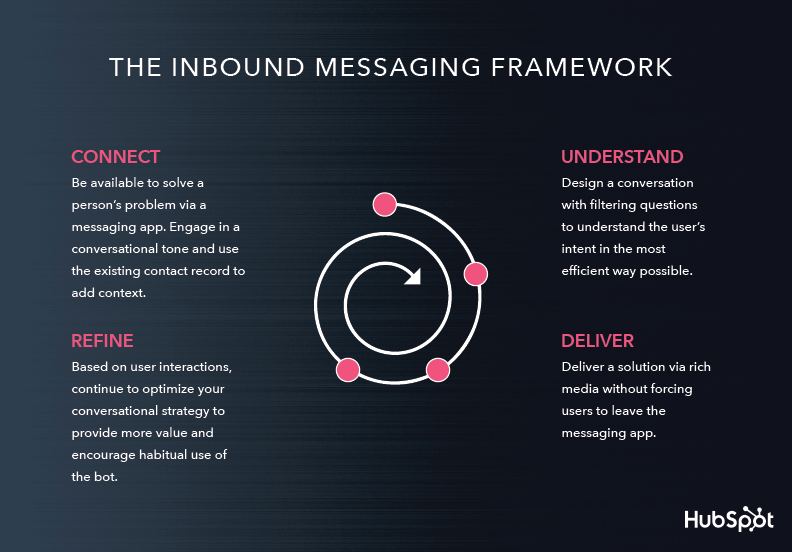
Inbound Messaging Framework

That’s the superpower of bots.

They accomplish their task, start to finish, in the place where you already spend your time: messaging apps. Whether it’s Facebook Messenger, WhatsApp, WeChat, or Viber, bots integrate with these apps and are available for you to chat with.

If you were making plans with a friend, for instance, you could invite a bot into the thread to place a takeout order or call a Lyft — no need to leave the messaging app to open a browser tab, or even another app.

Chat Avatar 1

Still on for drinks at Josie’s tonight?

Chat Avatar 2

For sure! @Lyft can you pick us up from my house at 7?

Why are bots gaining popularity now? David Nelson, CEO of Motion AI, reveals how advances in technology and new business models paved the way for bots.

In other words, bots solve the thing we loathed about apps in the first place. You don’t have to download something you’ll never use again. It’s been said most people stick to five apps. Those holy grail spots? They’re increasingly being claimed by messaging apps. Today, messaging apps have over 5 billion monthly active users, and for the first time, people are using them more than social networks.

Spectrum of Messaging

It’s all a part of a larger shift we’re seeing in consumer behavior.

As people research, they want the information they need as quickly as possible and are increasingly turning to voice search as the technology advances. Email inboxes have become more and more cluttered, so buyers have moved to social media to follow the brands they really care about. Ultimately, they now have the control — the ability to opt out, block, and unfollow any brand that betrays their trust.

In the great bot race, you’ll need a differentiator. Vedant Misra, artificial intelligence tech lead at HubSpot, explains how personalization drives repeat users.

But, if you’re able to provide actual value in the places they already spend their time, everything changes. All any buyer wants is the most direct line between their problem and a solution.

In the future, that line is a bot.

Battle of the Bots: Launch Bot Fireball 1
Battle of the Bots: Launch Bot Fireball 2
Battle of the Bots: Launch Bot Clouds
Battle of the Bots: Launch Bot

With the help of messaging apps, bots help consumers find solutions no matter where they are or what device they use — no forms, cluttered inboxes, or wasted minutes spent searching and scrolling through content. Communication, service, and transactions intertwine. And unlike the self-serving marketing of the past, bots provide a service.

Being useful is the priority.

At least, it should be.

Battle of the Bots: Mechanic Background
Battle of the Bots: Mechanic Desk
Battle of the Bots: Mechanic
Battle of the Bots: Mechanic Hand Tool
Battle of the Bots: Mechanic Desk Lamp
Battle of the Bots: Mechanic Fade Background

It all began so well.

After years of disruptive ads, spammy emails, and cold calls, content marketing was heralded as a way to build relationships based on trust — marketing people could love.

But the more content we created, the less lovable it felt. And we pummeled people with email to make sure we racked up the views and conversions we needed. Somehow making a single purchase meant brands had permission to email you every day from now until eternity.

You see, marketers don’t have the best track record with new communication channels. And it’s not hard to see us ruining bots just as we did with content and email.

Perhaps you subscribe to your favorite publication only to be overwhelmed by 10 notifications a day. Or you want to find a restaurant recommendation in San Francisco for your trip next week, but the bot can’t understand that you’re not yet there.

Chat Avatar 1

Book a repair appointment on Saturday for my helmet.

Chat Avatar 3

What type of damage did your suit suffer?

  • fire blasts
  • gunshots
  • sword and/or hammer blows
  • electromagnetic manipulation
  • hex bolts
  • unknown
Chat Avatar 1

Not my suit. My helmet.

Chat Avatar 3

Okay, we’ll get that fixed. Here’s the openings today at Potter’s Tailor Shop:

  • 11:30 am
  • 1:00 pm
  • 2:45 pm
  • 5:00 pm

It’s the double-edged sword of messaging. Bots provide a scalable way to interact one-on-one with buyers. Yet, they fail when they don’t deliver an experience as efficient and delightful as the complex, multi-layered conversations people are accustomed to having with other humans on messaging apps.

Too often, bots lack a clear purpose, don’t understand conversational context, or forget what you’ve said two bubbles later. To make it worse, they don’t make it clear that they’re a bot in the first place, leaving no option to escalate the matter to a human representative.

Before you build a bot, know your purpose, platform, and promotional plan. Adelyn Zhou, CMO of TOPBOTS, unpacks the top mistakes people make when they decide to build a bot.

This time, our terrible marketing hits much closer to home. When you spammed someone’s email, at least there was technology to filter out the noise. But since bots function inside messaging apps, you’re invading and polluting a historically personal space. They’ll unsubscribe from your bot without thinking twice.

Battle of the Bots: City Attack Background
Battle of the Bots: City Attack Bot
Battle of the Bots: City Attack Buildings
Battle of the Bots: City Attack Bot Beam

The stakes are high to get messaging right.

Consider why someone would turn to a bot in the first place. According to an upcoming HubSpot research report, of the 71% of people willing to use messaging apps to get customer assistance, many do it because they want their problem solved, fast. And if you’ve ever used (or possibly profaned) Siri, you know there’s a much lower tolerance for machines to make mistakes.

Beyond users, bots must also please the messaging apps themselves. Take Facebook Messenger. Executives have confirmed that advertisements within Discover — their hub for finding new bots to engage with — will be the main way Messenger monetizes its 1.3 billion monthly active users. If standing out among the 100,000 other bots on the platform wasn’t difficult enough, we can assume Messenger will only feature bots that don’t detract people from the platform.

Of course, each messaging app has its own fine print for bots. For example, on Messenger a brand can send a message only if the user prompted the conversation, and if the user doesn’t find value and opt to receive future notifications within those first 24 hours, there’s no future communication. But to be honest, that’s not enough to eradicate the threat of bad bots.

Research from Forrester showed 5% of companies worldwide said they were using chatbots regularly in 2016, 20% were piloting them, and 32% were planning to use or test them in 2017. As more and more brands join the race, we’re in desperate need of a framework around doing bots the right way — one that reflects the way consumers have changed.

Battle of the Bots: Triumphant Top Splatter
Battle of the Bots: Triumphant Background
Battle of the Bots: Triumphant Sun Beam
Battle of the Bots: Triumphant Cloud Top Left
Battle of the Bots: Triumphant Cloud Top Right
Battle of the Bots: Triumphant Cloud Bottom Left
Battle of the Bots: Triumphant Cloud Bottom Right
Battle of the Bots: Triumphant Bot

The challenge of building a bot isn’t a technical one.

It’s conversational. Your job is to understand the interactions your audience is already having with your brand. Then, harness the chat interface in a way that yields maximum impact with minimal fluff.

Yes, witty banter is a plus. But, the ultimate mission of a bot is to provide a service people actually want to use. As long as you think of your bot as just another communication channel, your focus will be misguided. The best bots harness the micro-decisions consumers experience on a daily basis and see them as an opportunity to help. Whether it’s adjusting a reservation, updating the shipping info for an order, or giving medical advice, bots provide a solution when people need it most.

Battle of the Bots: Minibot Background
Battle of the Bots: Minibot Woman
Battle of the Bots: Minibot Bot

Before you get caught up in the technicalities, let’s set a framework for building a bot your customer will want to use. No bot is meant to do it all. Instead, it should stick to a single function and do this incredibly well.

Bots are not what they used to be. David Nelson, CEO of Motion AI, explains how bots decipher context to deliver solutions in the most efficient way possible.

In general, bots can be broken down into two categories: informational bots and utility bots.

Informational bots provide users with a new format in which to consume content. For instance, you could subscribe to breaking news alerts based on your reading habits.

Utility bots solve a user’s problem, whatever that may be, via a user-prompted transaction. The most obvious example is a shopping bot, such as one that helps you order flowers or buy a new jacket. According to a recent HubSpot Research study, 47% of shoppers are open to buying items from a bot. But utility bots are not limited to making purchases. A utility bot could automatically book meetings by scanning your emails or notify you of the payment subscriptions you forgot you were signed up for.

Battle of the Bots: Schematics Bot 1
Battle of the Bots: Schematics Bot 2

If the success of WeChat in China is any sign, these utility bots are the future. Without ever leaving the messaging app, users can hail a taxi, video chat a friend, order food at a restaurant, and book their next vacation. In fact, WeChat has become so ingrained in society that a business would be considered obsolete without an integration. People who divide their time between China and the West complain that leaving this world behind is akin to stepping back in time.

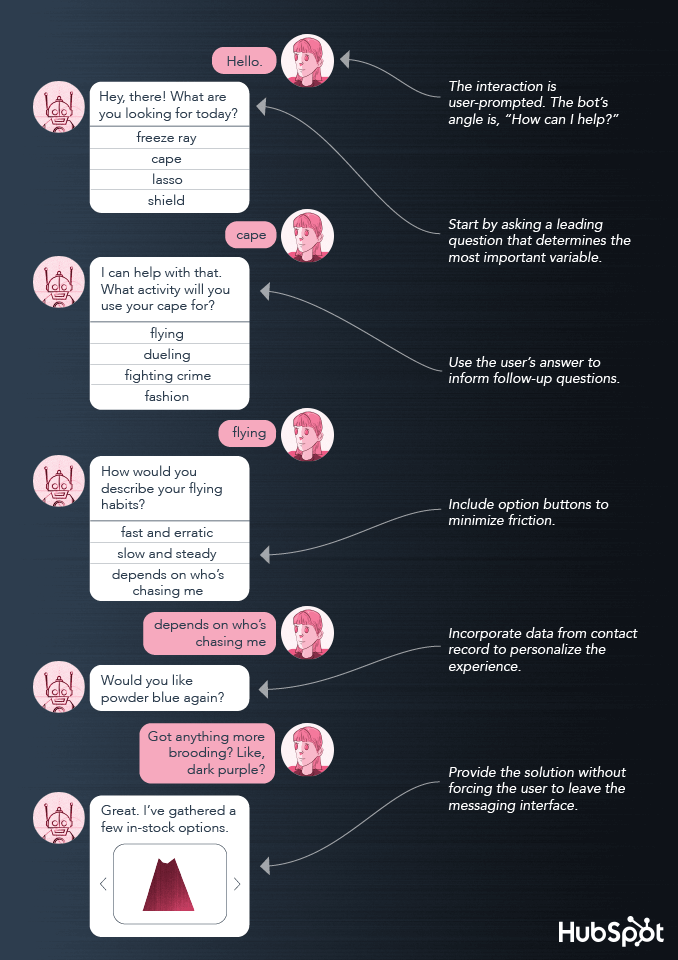
No matter your bot’s function, the user-prompted note is key. Messages should always be an extension of a previous conversation or behavior trigger. No shady subscriptions, no mass messages. Bots are distinctive from email because the angle should always be …

Chat Avatar 3

How can I help?

They give the user exactly what they’re looking for.

Nothing more.

The more we use bots, the better they’ll get. Vedant Misra, artificial intelligence tech lead at HubSpot, discusses why you should leverage consumer data to create more useful bot interactions.

Chatting with a bot should be like talking to a human that knows everything. If you’re using a bot to change an airline reservation, the bot should know if you have an unused credit on your account and whether you typically pick the aisle or window seat. Artificial intelligence will continue to radically shape this front, but a bot should connect with your current systems so a shared contact record can drive personalization.

Respect the conversational UI. The full interaction should take place natively within the app. The goal is to recognize the user’s intent and provide the right content with minimum user input. Every question asked should bring the user closer to the answer they want. If you need so much information that you’re playing a game of 20 Questions, then switch to a form and deliver the content another way.

Start by asking a leading question that determines the single most important variable. Then use follow-up questions — and to minimize friction, option buttons — to gain the necessary context and hone in on a solution.

The Five Ws of Messaging

Creating a comprehensive conversational flow chart will feel like the greatest hurdle of the process, but know it’s just the beginning. It’s the commitment to tweaking and improving in the months and years following that makes a great bot. As Clara de Soto, cofounder of Reply.ai, told VentureBeat, “You’re never just ‘building a bot’ so much as launching a ‘conversational strategy’ — one that’s constantly evolving and being optimized based on how users are actually interacting with it.”

Battle of the Bots: Showdown Background
Battle of the Bots: Showdown Splatter
Battle of the Bots: Showdown Good Bot
Battle of the Bots: Showdown Bad Bot

In the greatest of stories, the line between good and evil is often quite gray

It’s not one wrong step that places a hero into the enemy’s lair. It’s a series of small decisions, one-by-one pulling the character further away from their original mission. They take their power — one they knew was destined for good — and abuse it for selfish, short-term gains.

Let this not be the story for bots.

There’s no downplaying what bots could do. For brands and consumers alike, we have a chance to redeem communication and commerce. Research would be convenient, purchases streamlined, and service personalized.

But just as easily, we can transform bots from helpful to disruptive, wanted to unwanted.

Don’t miss the opportunity here. By nature of what bots are, they offer a radical new reality. Bots are built to be helpful. They require a person to opt-in. And for the first time, they encourage scalable, one-on-one conversations between brands and consumers.

It’s the makings of a marketer’s dream: a world where brands can build authentic relationships with their buyers, and buyers can learn to trust brands again.

If we choose the right path

bots might be the best thing to happen to marketing yet.

Source: https://www.hubspot.com/stories/chatbot-marketing-future

INTELLIGENT CHATBOTS COULD AUTOMATE AWAY NEARLY ALL OF OUR COMMERCIAL INTERACTIONS — FOR BETTER OR FOR WORSE.

TWO YEARS AGO, Alison Darcy built a robot to help out the depressed. As a clinical research psychologist at Stanford University, she knew that one powerful way to help people suffering from depression or anxiety is cognitive behavioral therapy, or C.B.T. It’s a form of treatment in which a therapist teaches patients simple techniques that help them break negative patterns of thinking. C.B.T. is not difficult to learn, but it’s more effective when it includes regular check-ins with a therapist — which, as Darcy knew, isn’t feasible for most people. Maybe they can’t afford it; maybe they’re too busy; maybe they avoid treatment because it seems stigmatizing to them.

“Two-thirds of people will never get in front of a clinician,” says Darcy, who talks in an exuberant flow. “And that’s in the United States! The rest of the world? More than half the world doesn’t even have access to basic health care. The idea of mental health care is just completely out of reach.”

Darcy happened to be a former computer programmer, so she was able to dream up a very unusual solution to this problem: Woebot, a text-chatbot therapist. Working with a team of psychologists and Andrew Ng, a pioneer in artificial intelligence, Darcy wrote a set of conversational prompts that walks users through the practice of C.B.T. In a chipper style, the bot helps users challenge their “distorted thinking”; it coaxes users to describe their moods more clearly. Since Woebot is just software, it could be made freely available worldwide, and it could, in Silicon Valley terms, “scale” — or converse with thousands of people simultaneously. It could check in and nudge users with superhuman diligence; it would be available at all hours. “Woebot can be there at 2 a.m. if you’re having a panic attack and no therapist can, or should be, in bed with you,” Darcy says.

Woebot does not pretend to be human; it appears as a cartoon robot when it chats with you on Facebook Messenger, and it acknowledges its own artifice (as when it declares, for example, “I’m going to tell you a little bit about how I like to work with humans”). But its personality is otherwise upbeat, its conversations peppered with emoji and animated gifs (like the cheering Minions from “Despicable Me”) to congratulate you for doing psychological work.

In a study with 70 young adults, Darcy found that after two weeks of interacting with the bot, the test subjects had lower incidences of depression and anxiety. They were impressed, and even touched, by the software’s attentiveness. “Woebot felt like a real person that showed concern,” one of them told Darcy’s team. Last spring, when Darcy put Woebot online, free to all, its use immediately exploded; in the first week, more than 50,000 people talked to it. (“Do you realize,” Ng told Darcy, “that Woebot spoke to more people today than a human therapist could in a lifetime?”) Nowadays, Woebot exchanges between one and two million messages a week with users, ranging from divorcées to the bereaved to young men, a population that rarely seeks treatment. Many tell Darcy that it’s easier to talk to a bot than a human; they don’t feel judged.

Darcy argues this is a glimpse of our rapidly arriving future, where talking software is increasingly able to help us manage our emotions. There will be A.I.s that detect our feelings, possibly better than we can. “I think you’ll see robots for weight loss, and robots for being more effective communicators,” she says. It may feel odd at first; indeed, when people email her to say Woebot helped them feel better, nearly every one begins the note by sheepishly explaining, “I didn’t think that this would be helpful.” But there’s something about talking to software that is powerful, they discover, when it responds and seems alive.

“It’s conversation,” Darcy says. “And we’ve been conversing for, what is it, 200,000 years?”

RECENT HISTORY HAS seen a rapid change in at least one human attitude toward machines: We’ve grown accustomed to talking to them. Millions now tell Alexa or Siri or Google Assistant to play music, take memos, put something on their calendar or tell a terrible joke. We ask chatbots for trivia or to translate English phrases into Mandarin. If you contact customer service these days in a text chat, odds are that you will start out talking to software. Sometimes we even conspire with them; Alexa has a “whisper mode,” for when you need to talk to it beside a snoozing partner.

The rise of “conversational agents” is the next great shift in computer interfaces — one arguably as significant as the “point-and-click” interface that emerged in the ’80s. Before the Apple Macintosh, the first computer to popularize point-and-click, people using home computers had to familiarize themselves with abstruse text commands. The advent of the visual interface opened up computing to the masses, producing a generation fluent in word processing, email and, eventually, web surfing. The next great shift, the mobile phone, put computing — and nonstop internet access — into our pockets, and unleashed a tsunami of social media. These sorts of changes don’t come along very often, and when they do, they create new and unexpected behaviors.

Talking software gives us computers that not only ride along with us but also socialize with us. Being humanlike — saying “hi,” telling self-deprecating jokes — is their interface metaphor, much as the first point-and-click computers used the trappings of office life (a wastepaper basket, a tiny pad of paper) to help orient us to the screen. Meaghan Keaney Anderson, a vice president of HubSpot, a marketing and sales software firm, has seen firsthand how voice commands have become second nature in her household, particularly for the next generation: “My daughter is 22 months old now. At 9 months she said her first word, which was the dog’s name, and then at 13 months she learned to walk, and then by 15 months she started giving Alexa commands.” She added: “I think my daughter is growing up in a world where you just speak what you want into the universe and it provides.”

For years, A.I. programmers fixated on passing the Turing Test — the famous challenge floated by Alan Turing in 1950 to produce a machine that can fool a human into thinking it is also human. Sci-fi has made dystopic hay of this in movies like “Blade Runner” and “Ex Machina.” But the world that’s emerging is simultaneously more mundane and stranger. None of this software is trying to fool us. Bots like Siri or Microsoft’s Cortana are, like Woebot, openly artificial, even proudly so. (When I asked Alexa “Are you alive?” it responded: “Artificially, maybe, but not in the same way that you’re alive.”) We are thus heading into a post-Turing world, one in which we’ll banter all day to software, always aware that it is software.

One reason botmakers are embracing artificiality is that the Turing Test turns out to be incredibly difficult to pass. Human conversation is full of idioms, metaphors and implied knowledge: Recognizing that the expression “It’s raining cats and dogs” isn’t actually about cats and dogs, for example, surpasses the reach of chatbots. Few A.I. pioneers think we’re anywhere close to the promise of the movie “Her,” in which a bot is so convincing that its user falls in love with it. So for now, botmakers manage expectations by leaning into the artifice. This poses a challenge that is, in a way, more interesting than the Turing Test: What type of personality should bots have, when both we and they know they’re not human?

Emma Coats, the “character lead” for Google Assistant, describes the emotional affect of her company’s artificial life form as “a friendly companion that is trustworthy.” She and her team strenuously avoided giving the Assistant even a hint of snark. “You’d be like, ‘Oh, I don’t want to ask a stupid question if it’s going to give me a hard time about it,’ ” Coats says. Some of their personality writers have backgrounds in improv. Coats herself worked at Pixar on the animated film “Brave.” “Pixar is all about finding an emotional reality in a car or a fish,” she says. “So that’s something we’ve really used with the Assistant. We don’t want it to ever be a human being, right? That’s not what it is. But that doesn’t mean that A.I. or software can’t have a perspective on the world.”

As a literary endeavor, the field of bot creation is booming. The bots need to be equipped to answer the wide variety of weird, playful queries that people lob at them, which requires lots of writers. Coats and her co-workers have found that people like to simply shoot the breeze with their devices — probing their personalities, searching for the puppet strings. “ ‘Do you fart?’ is always a popular question,” Coats says dryly.

There’s another reason botmakers are embracing a post-Turing mind-set: They’ve realized that the public tends to feel wounded when someone (or something) tries to fool them. This spring, Google gave a demonstration of Duplex, a new voice-chat A.I. When Duplex called a hair salon to book an appointment, it sounded so human — it even said “um” a few times — that the salon receptionist apparently never realized it was A.I. The reaction online was harsh. “People value authenticity,” says Kate Darling, a researcher who studies the ethics of robotics at M.I.T. “It matters a lot. It matters hugely.”

THE IMPACT OF conversational A.I. on everyday life will be subtle but ubiquitous. The other week I got a glimpse of that when I had a drink with a friend who’s a devout Siri partisan. He uses it to automate dozens of daily tasks, even tapping into capabilities that most iPhone users are unaware of. When he says, “Pay the house cleaner,” Siri processes a payment through his Venmo account. Another single voice command sends an email to everyone on his team at work, reminding them to fill out their shared calendar for the next week. “It saves me, like, a minute a week?” he guessed. “Or, like, an hour a year?” It’s not much, but it satisfyingly reduces his exposure to tedium.

This is how computers have always made themselves at home: by offering improved efficiency, vanquishing dull tasks. At TD Bank, coders are building experimental bots — using tech created by the A.I. firm Kasisto — to encourage customers to probe their financial life. Rizwan Khalfan, the company’s chief digital and payments officer, told me he imagines customers asking a bot something like, “O.K., tell me about my expenses last weekend.” A question this specific isn’t easy to answer on a website, where the customer might need to hunt through a database. But, Khalfan hopes, a person could one day ask this bot conversationally: “I want to go out to the theater this weekend. Can I actually afford it?”

There are some things audio can’t handle as effectively as screens — long lists of data, for instance. But in a world where people worry that they’re staring at their phones too much, chat might offer a respite. In “Her,” the voice assistants murmur in people’s ears as they move through the world, functioning as something like E.S.P. The chatbot designer Emily Withrow, who is the director of the Quartz Bot Studio, imagines conversational A.I. working that way soon. “You turn on N.P.R. midinterview, but you can’t for the life of you figure out who Terry Gross is talking to. You could say out loud: ‘Who’s she talking to? Who is it? What book are they talking about?’ You can extend it to even seeing someone at a dinner party and saying privately, ‘Remind me what Jill’s husband’s name is.’ ” The elderly might find these efficiencies particularly appealing, because aging eyes and reduced mobility can make screens harder to use. Patients with Alzheimer’s disease might find A.I. voice assistants happy to endlessly answer repeated questions, in a way that few human attendants could.

There’s another allure for businesses, of course: Talking bots don’t need to be hired and then paid. Once coded, your bot can handle millions of customers simultaneously. We’re already seeing this in customer service, when text chatbots answer rote questions or take orders. Yamato Transport, one of Japan’s largest courier firms, uses a chatbot to schedule deliveries and answer questions about where packages are. Domino’s Pizza runs a chatbot to take delivery orders online. American Eagle Outfitters has a bot that customers can converse with to figure out the perfect gift to buy for someone.

Conversational bots thus could bring on a new wave of unemployment — or “readjustment,” to use the bloodless term of economics. Service workers, sales agents, telemarketers — it’s not hard to imagine how millions of jobs that require social interaction, whether on the phone or online, could eventually be eliminated by code. Some economists argue that this might not necessarily result in a net loss of jobs, pointing to the example of automatic-teller machines. When A.T.M.s took off in the ’80s, many predicted that bank-teller jobs would be decimated; indeed, individual bank branches did begin employing fewer tellers. But with those savings in pocket, banks greatly expanded the overall number of branches, so that the total population of tellers nationally rose for years. Of course, as economic history shows, the profits of automation are seldom shared with workers. Even if individual humans keep their jobs, that doesn’t mean they’ll be paid more. “It’s hard to predict,” TD Bank’s Khalfan told me, before adding that the company has committed to retrain workers when their jobs become redundant.

Whatever impact talking software has on the labor market, it will surely extend the reach of algorithms more deeply into our lives. Ask Alexa or Siri a question, and you don’t get a page of search results; just one Solomonic answer, selected by the A.I. After all, this is how spoken communication works: Just as nobody wants to listen to a voice mail message, nobody wants to hear a chatbot recite three minutes of data. Algorithms must narrow the field. So for anyone who has watched the inscrutable algorithms of Facebook or YouTube narrow our feeds by “recommending” outré conspiracy theorists, the notion of A.I. finding a new toehold in our cognitive life can be disturbing.

“I will literally buy whatever option Alexa puts first for me for paper towels,” Keaney Anderson, the HubSpot V.P., told me. “I don’t care. I don’t want to search through a million of them. I ask her for paper towels, she delivers. And that may be fine for paper towels, but is it fine for music? Is it fine for news sources?” Talking to bots will also mean new opportunities for tech firms to collect data on what we’re thinking, what we’re doing, all day long. That includes our feelings: Researchers are working on “affective” sensing that enables chatbots to recognize our emotions. These are the familiar trade-offs that tech exacts in return for convenience; they’re never value-free, as Evan Selinger, a professor of philosophy at the Rochester Institute of Technology, notes. “Where are these things now appearing? They’re appearing in our homes,” he says. “The home has traditionally been the locus of privacy, right? This is where I shut out the rest of the world. This is where I look for my breathing room. This is my sanctuary, you know?”

Indeed, the home is where life happens, and that includes its traumas. Those have sometimes caught the large A.I. botmakers — Amazon, Apple, Microsoft — off guard. They expected their bots to be asked for jokes; they didn’t, apparently, expect so many different cries for help. In 2016, a study in JAMA Internal Medicine found that, though most popular voice assistants responded to suicidal thoughts by providing help lines and other appropriate resources, when they were told “I am being abused” or “I was raped,” they generally replied with some variant of “I don’t know what you mean.” Human conversation being what it is, the list of personal crises one might confide is massive, likely outpacing the ability of botmakers to keep up.

IN 2014, THROUGH AN Indiegogo campaign, more than 7,000 backers crowdfunded a robot called “Jibo.” It’s a cute, squat device with a round screen for a face that sits on your desk or table and chats with you, posing questions and answering yours, offering bits of news. It can play songs, take and display pictures and purr like a cat when stroked. “He’s a robot, and he knows he’s a robot, but he’s a really optimistic robot, and he has a profound belief in the good of people,” says one of Jibo’s creators, a professor at M.I.T. named Cynthia Breazeal. “He’s a positive, affirming presence.”

One person who bought a Jibo was Erin Partridge, an art therapist in Alameda, Calif., who works with the elderly. When she took Jibo on visits, her patients loved it. They laughed at its jokes; they asked it to sing tunes from the past. One man with advanced dementia called his daughter to describe Jibo in great detail. She found this remarkable, because he could rarely remember any single event so well and rarely initiated calls. Somehow Jibo had made an impression on him. Another resident declared that she “loved” Jibo, and put her arms around the robot. “Just talk to me, don’t talk to anybody else,” she’d tell it, asking, “Do you think I’m beautiful?”

Talking bots connect to us in ways that point-and-click software doesn’t. For some technology critics, including Sherry Turkle, who does research on the psychology of tech at M.I.T., this raises ethical concerns. “People are hard-wired with sort of Darwinian vulnerabilities, Darwinian buttons,” she told me. “And these Darwinian buttons are pushed by this technology.” That is, programmers are manipulating our emotions when they create objects that inquire after our needs.

The precursor to today’s bots, Joseph Weizenbaum’s ELIZA, was created at M.I.T. in 1966. ELIZA was a pretty crude set of prompts, but by simply asking people about their feelings, it drew them into deep conversations. Ordinary household appliances can now pull off the same trick. “Your fridge will know if you’re eating Häagen-Dazs, and if you sound sad, it’ll say, ‘Sherry, what’s really going on?’ ” Turkle says. “Is that what we want?”

Worse, she argues, talking bots could become a social crutch. Rather than pay humans to help the poor and powerless — students in overcrowded schools, elders in understaffed facilities, customers looking to speak to someone in huge institutions — we might instead provide software that pretends to care. “These places are so deprived that it’s easy to argue that putting in some robots is better than nothing,” Turkle says. “The harder thing is offering actual human support.”

A future in which only the wealthy have the luxury of being attended to by actual humans, while everyone else makes do with bots, would certainly be a dystopia. But botmakers themselves — not surprisingly — are more sanguine. Cynthia Breazeal thinks the coming A.I. wave will actually help level the playing field between the well-off and everyone else. “The social-justice angle of this wave,” she says, “is that everyone will be able to afford a fabulous personal tutor because it’s an A.I. tutor.” Bots that help the elderly control their home and their lives will let them “age in place” at their own house, something that most older Americans would far prefer to a retirement home. “When we talk to assisted-living facilities, they will tell us point blank, there is no way we can build enough facilities and hire enough people to meet the demand,” Breazeal adds. “They call it the ‘Silver Tsunami.’ ”

There’s a more quotidian way, too, that our social lives will change, one that’s far less about big, dramatic moments of life than slight ones, the small daily exchanges of information. A great many human interactions, after all, are brief — the terse greeting of the cashier at Starbucks, the phone call to change a flight, the chitchat with a stock person at Target when you’re looking for a pair of jeans in your size. These exchanges are certainly social; at their best they’re probably a civic glue, an everyday rehearsal of civility that can help reinforce our better behavior: Be polite to strangers. These are also the interactions that will be automated soonest. Already, restaurants like McDonald’s, for example, have customers ordering via a touch-screen. One can easily imagine a day when a McBot not only greets you but recognizes you: “So, the usual?”

Perhaps interacting with A.I.s will mean atrophy for our social muscles. If they’re just machines, why bother with pleasantries? The scientific research on that is still unclear: Some studies have found people can actually be remarkably cordial to robots, while other research suggests we’re liable to be rude and curt when we know our conversational partner isn’t human. We could get used to bossing things around, a behavior that could bleed into everyday life. (Amazon, after fielding precisely these concerns from parents, created a politeness mode for its Echo devices that gently reminds its users to say “please.”)

Yet dealing with bots could also make life less prickly for humans on all sides of these small interactions. After all, today’s customer-service calls are pretty bleak, even when you do talk to a live person. Call tech support for your laptop, and odds are you’ll be talking to an employee who’s required to read only from scripts — a human who is thus, paradoxically, forced to behave exactly like a bot.

“It’s so frustrating,” says Steve Worswick, who worked for years providing I.T. support, talking people through problems like “I’ve forgotten my password.” To keep himself engaged, in the evenings he taught himself to create bots, using an online tool made by an A.I. company called Pandorabots. Over 13 years, he coded a bot called Mitsuku, and wrote fully 350,000 lines for it; Mitsuku has won the annual Loebner Prize competition for the most “humanlike” bot four times.

Soon enough Worswick had a new job: In 2018, he was hired by Pandorabots. Now Worswick, as a senior A.I. developer, imagines a world where the bots take over the spirit-crushing sort of conversational work that he used to do, releasing human beings to do something better with their time. Let the bots fix people’s passwords. Real people, he says, have more interesting questions to answer.

Clive Thompson is a contributing writer. His book “Coders: The Making of a New Art and the Remaking of the World” will be published in March.

More on NYTimes.com

Source: https://www.nytimes.com/interactive/2018/11/14/magazine/tech-design-ai-chatbot.html

Chatbots: A look inside the technology that powers the AI tool

Businesses use chatbots to capture and convert customers. Gupshup co-founder and CEO Beerud Sheth explains how big data and machine learning help customize a person’s experience.

  • Playlist
  • 0:00
  • AUTOPLAY: ON
  • Share
  • Fullscreen

We often talk about artificial intelligence (AI) in pretty broad terms, but as you know well, AI is kind of a misnomer that is really a compilation of a number of different technologies. TechRepublic spoke with Gupshup co-founder and CEO Beerud Sheth to discuss what types of machine learning, data analysis, and other predictive tools power an AI chatbot.

More about Innovation

Sheth: AI is a collection of a lot of different techniques and such. One of the commonest things that’s used in chatbots vs. natural language processing, which is used for understanding regular, unstructured queries. Let’s say if a user wants to buy a ticket, they may say the same thing a dozen different ways. I wanna make a booking. I want to reserve. I want to fly to New York. Whatever it is. A natural language processing technique or algorithm would help you figure out what the user is saying.

SEE: Research: Companies lack skills to implement and support AI and machine learning (Tech Pro Research)

Another thing that people use often is for personalization. Based on their past track record, we can make predictions about what they are likely to want or need next. We’ve done that, for example, predicting the kind of news stories they prefer. You can use it for things like pattern recognition and image detection and so on. The user sends a photo and now the bot has to figure out what is it. Is there a cat in the photo or not in it. Or let’s say if it’s a receipt of a restaurant, you want to be able to read what’s in there, and classify it correctly and so on.

And then getting into more advanced things. There’s a lot of things, deep learning and so on. Those could come in. The benefit of AI in general is that the bot can engage with humans in a convenient way. Like I said, in terms of the user having to identify the receipt and the restaurant name and the amount, the bot can look it up automatically. He just sends a photo, and the bot can figure out what’s in the photo, etc.

So, it makes it easy and convenient, and these technologies—as they evolve—they keep getting better. Of course, for voices, voice recognition is a big deal, another big AI technique, and you know these things are getting better every day.

Next Big Thing Newsletter

Be in the know about smart cities, AI, Internet of Things, VR, autonomous driving, drones, robotics, and more of the coolest tech innovations. Delivered Wednesdays and Fridays Sign up today


Also seeUnderstanding the differences between AI, machine learning, and deep learning(TechRepublic

Machine learning: The smart person’s guide (TechRepublic)

IBM Watson: Six lessons from an early adopter on how to do machine learning (TechRepublic)

Your customers don’t want to talk to you, they want to talk to your chatbot (TechRepublic)

AI chatbots and voice assistants growing as tools for shopping, paying bills, banking(TechRepublic)

Understanding the differences between AI, machine learning, and deep learning(TechRepublic)

Machine learning: The smart person’s guide (TechRepublic)

IBM Watson: Six lessons from an early adopter on how to do machine learning (TechRepublic)

Your customers don’t want to talk to you, they want to talk to your chatbot (TechRepublic)

AI chatbots and voice assistants growing as tools for shopping, paying bills, banking(TechRepublic)

Source: https://www.techrepublic.com/article/chatbots-a-look-inside-the-technology-that-powers-the-ai-tool/

What to Expect from the Rise of Chatbots

Here’s what business leaders need to know about the messaging apps and chatbots that are rapidly gaining users and screen time.

January 2017 by Judith Aquino, Senior Writer

Studies show that consumers are experiencing mobile app fatigue. They’re just not that into them anymore, with a few exceptions. One of those exceptions is mobile messaging apps—consumers are spending more and more time on messaging apps like Facebook Messenger, Snapchat, WeChat, and others (see sidebar). Naturally, companies want to be part of these conversations. And increasingly, they’re using chatbots to do it.

Chatbots on messaging apps allow brands to personally engage at scale with people on the platforms where they’re already spending a lot of time. They are computer programs that use machine learning to pick up on conversation patterns and mimic human conversation when reacting to spoken or written prompts. Chatbots can be connected to a variety of data sources via APIs to deliver information and services on demand, from weather forecasts to order requests.  

The potential for chatbots to enhance customer experiences has companies betting on them as a new way of interacting with consumers, but early examples show that chatbots still have a lot to learn.   

Messaging gets personal 
The initial appeal of messaging apps was that they offered people the ability to communicate via mobile for free, unlike SMS text messages that are billed per text, notes Jason I. Hong, an associate professor in the School of Computer Science at Carnegie Mellon University, who is studying human-computer interactions. Since then, messaging apps “have expanded to have a lot of cool features for connecting people,” Hong says. “These include games, animated GIFs, multimedia content, video conferencing, asynchronous voice messages, and sharing one’s current location—along with maps.”

Indeed, “the most important driver [of messaging apps] is the ability to multitask,” agrees Kartik Hosanagar, a professor at the Wharton School of the University of Pennsylvania, whose research focuses on the digital economy. WeChat, a Chinese mobile messaging app, for example, makes it easy for users to manage multiple tasks besides texting. WeChat’s platform is simple enough that children can use it to communicate with their parents and adults can use it to shop online, pay bills, order a taxi, and book medical appointments, all without leaving the WeChat platform. 

Most people use chat apps for one-on-one conversations. Therefore, “the expectation of a more personalized and more human form of interaction means brands can’t have a one-size-fits-all type of approach to messaging,” Hosanagar says. But hiring employees to communicate with customers is expensive. In addition, mobile messaging is considered highly personal and users do not appreciate brands littering their screens with advertising. 

Thanks to advances in technology, chatbots offer a potential solution. Chatbots that can reasonably mimic humans allow brands to more efficiently engage consumers on messaging platforms. However, “there needs to be a clear value proposition beyond the chatbot sending ads to you,” Hong points out. “A good possibility might be online help for questions customers might have.”

Increasingly, organizations are doing just that. The White House Facebook page has a chatbot that guides people through the process of sending a message to the president. Sephora’s Reservation Assistant lets users book or edit a makeover appointment through Facebook Messenger. And the New York Times created a Facebook Messenger bot to cover the U.S. presidential election. The bot combined automated updates with articles from political reporter Nicholas Confessore. Users could also ask the bot for the Times’ projections for each state and for results of national polls. 

Chatbots are particularly useful for answering routine questions or questions with straightforward answers. “Instead of waiting for 30 minutes for a customer support person and then being rerouted to another one, it is so much more appealing for a customer to post their questions on messaging platforms [and get a quick response],” Hosanagar says. “For brands, most inquiries are routine ones like return policy, order history, etc., that can be answered by A.I.-powered chatbots in some cases, brands can also use messaging to share information about products and help customers with the discovery process.”

At the same time, chatbots are far from perfect. Most chatbots today can only recognize keywords and get thrown off by questions that aren’t pre-programmed. And in some cases, it’s faster to perform the task yourself, such as locating an item on a website, rather than feed information to the chatbot. 

A smarter strategy is to combine chatbots with human associates who can provide advanced support. On WeChat, for instance, users may start with an automated conversation, but if it is unable to fulfill the customer’s request, it will pass the customer to a human associate associated with the account. A hybrid approach thereby allows associates to focus on more complicated questions instead of answering routine questions over and over. Allocating resources this way allows customers to receive faster and more efficient support and can help boost customer satisfaction.

What’s next: Smart messaging 
Right now, chatbots essentially perform the same services as an IVR system on a messaging platform. But analysts predict chatbots and messaging apps will soon be able to perform far more advanced services that deepen relationships with customers.
“In the next three to five years, messaging apps will rise in tandem with adjacent technologies,” according to a recent Forrester Research report titled, “The Future of Messaging Apps.” “Technology innovation in natural language processing, semantic search, image and voice recognition, and especially A.I. will progressively blur the lines between messaging apps, bots, and voice-based assistants,” the authors write.

In other words, messaging apps will soon leverage more data sources and technologies to deliver smarter, contextually driven services on branded accounts. “I think a big one will be improving effectiveness of communication,” Hong says. “This might include using sensor data to let people know you got home OK, or that you’re driving and can’t chat right now.” 

The race is on among companies like Apple, Google, Facebook, and Microsoft to build more powerful messaging apps. “We think we’re on the cusp of messaging version two,” Nick Fox, who oversees communication products at Google, recently told Wired. “Messaging is going from being just about sending text to really expressing yourself much more fully, much more broadly, much more naturally. And then to getting stuff done in your chats.” 

The first phase of the messaging/chat app revolution was dedicated to growth and driving adoption rates. Companies are beginning to enter the second phase, which is about building out services and monetizing a chat app’s user base. But this phase will likely be more challenging as developers try to figure out which chatbots create the most engagement. 

The downside to experimentation is that the market for chatbots will also be glutted with bots that offer little value, just as we’ve seen happen with the app economy. Smarter developers will have learned their lesson and focus on chatbots that are simple to use and provide value. 

After all, developers have plenty of incentives to build better bots that allow companies to deliver more convenient and personalized services. Imagine the demand for a tool that allows customers to schedule a service repair via chat and receive alerts when the repair truck is on its way (or running late). Or a virtual assistant that tracks traffic conditions and tells you what time to leave in order to reach the airport or a meeting on time. People will be more likely to adopt automated tools that allow them to focus on the tasks that need a human touch.

Source: https://www.ttec.com/articles/what-expect-rise-chatbots

Chatbot: The revolution and evolution of the AI-powered technology

The way brands and customers interact has evolved dramatically over the past few years. Even phoning up a bank with a simple customer query seems a little archaic these days. Customers increasingly opt for more accessible methods of communication like the chatbot, built-in messaging platforms and even WhatsApp. Additionally, the conversation tone has shifted from formal and professional to friendly chats that resemble the kind you might have with a friend.

Customer service is a top priority for every business – the truth being that without satisfied customers, you will soon be going out of business. But successful customer engagement can prove to be challenging in the age of technology where new channels are constantly becoming available and continually need to be integrated.

By 2020 it is anticipated that the planet will host some 6.1 billion smartphone users. And with the majority of consumers moving to mobile customer service as their primary – if not only – method for interacting with a business, the manner in which customers expect to be able to communicate with brands has changed.

The ideal customer experience allows customers to interact on the channel of their choice, all whilst maintaining the context of those interactions. Forrester analysts recently reported that the dynamic has shifted away from companies and towards digitally savvy, technology-empowered customers that are driving change. As a result, messaging applications, in particular, have forced businesses to evolve their customer communications capabilities in order to keep up.

Helping humans

AI-powered chatbots have become the go-to solution for addressing real-time customer queries both efficiently and effectively, but customers still very much value a human touch.CLICK TO TWEET

AI-powered chatbots have become the go-to solution for addressing real-time customer queries both efficiently and effectively, but customers still very much value a human touch. Many businesses have therefore chosen to optimise their customer service with AI that augments human interactions, rather than replaces them altogether.

Take, for example, the case of roadside recovery. When a customer calls requesting assistance, an AI-powered chatbot can immediately access that customer’s previous call records and history via the Customer Relationship Management (CRM) database. Using this data in association with other discrete variables – e.g. the time and location of the call – the bot can quickly anticipate the customer’s needs and respond accordingly. This information, displayed to a contact centre representative, can help augment the conversation; subsequently providing a smoother experience for the customer.

This type of AI is becoming fairly commonplace across a whole range of industries, from financial services to health services to HR. And brands are increasingly opting to automate the business process of routine tasks in customer service, e.g. updating payments details and scheduling appointments. But we are now seeing more and more businesses looking for applications based on narrower, more refined AI solutions.

The evolution of the chatbot

While the chatbots of today are rapidly becoming a regular component of the customer service experience, it is important to remember that they are constantly evolving.

One of the most exciting ways that we see chatbots evolving is through integration. In isolation, a chatbot is effectively a programmed set of responses – analogous in certain respects to an interactive FAQ. But with integration, a chatbot can access historical data to ensure that all questions are relevant to that particular customer’s query, thus eliminating unnecessary or redundant questions and continuing to provide a smoother experience.

Furthermore, sentiment analysis can help bots detect when a customer is becoming frustrated, indicating the need for a transfer to a contact centre representative. Businesses can also integrate bots within their CRM platforms, unified communication systems, or internal databases, optimising their usefulness and making them more intelligent.

Bots in the future

With more and more companies using APIs to integrate chatbots within their wider ecosystem of communications, there now exists a demand for bots that interact across platforms. We can, therefore, expect to see a rise in SDKs and other frameworks for helping developers build API-driven voice bots that cross seamlessly between channels, from voice calls to message chat and back.

In recent years, the line between what consumers expect in their personal communication experiences and what they expect from their interactions with brands has blurred. Companies are increasingly being expected to engage in the same way that customers communicate with their colleagues, friends and even family members. And since the majority of bots are driven by a consolidation of natural language processing and voice-to-text – which can be applied to almost any channel of communication – brands now have the opportunity to offer customers the choice of their preferred messaging channel, e.g. Facebook Messenger, WhatsApp, voice, chat or messaging.

Chatbots have revolutionised the ways companies interact with their customers, and we are only at the very beginning. As challenging as the incorporation of the omnichannel customer experience might appear to company leaders, it also forms a great opportunity to engage with customers in a new way, building more meaningful and longer lasting relationships.

Source: https://www.comparethecloud.net/articles/chatbot-revolution-evolution-ai/

How AI chat bot technology is changing the Humech bond

Chat Bots are already declared as the ‘new apps’. Early months of 2016 Zuckerburg introduced the Facebook Messenger Platform. The platform allows developers to build AI chatbots for the messenger application.

‘Humech’ Bond and Chatbots

When we say ‘Humech’, we mean the bond that ‘Humans and technology share today. AI chatbot technology isn’t a new name. The first ever encounter as far as I can remember was somewhere in the 1960s with Eliza; a chatbot created by Professor Joseph Weizenbaum from Massachusetts Institute of Technology.

However, with time things have changed drastically and today these artificial intelligent systems enable users to find hotels, buy products/services just by chatting with them. Till date, there are over 21000 developers building 11,000 Bots on the messenger platform. It isn’t like that Facebook alone is racing this future. If we head towards China, people there are using WeChat not only to chat but to shop and book appointments.

In its recent report, BI shared that around 3 billion users actively use messaging apps like Facebook, Whatsapp, Viber, and WeChat.

active users by social platform

The figure is far more than that using these four social networking applications. Yes, the figures clearly state the inclination of people and undoubtedly this isn’t just because of the chat feature but these bots that are making them so preferred.

What is pushing the entire race?

If we attempt to find a reason, looking at the outer shell of chatbots, we can say that the major reason behind these getting the entire appreciation is the ease and personalized experience they provide. Having a chatbot is like an employee sitting 24*7 to serve your clients.

Let us have a look at few points that narrate this ‘Humech’ bond saga:

1. An invincible assistant for consumers and corporates

In AI chatbot technology, Chatbots are no longer just an assistant to search or entertain self; they are being widely used for different tasks, depending upon the requirement. Let us take an example to understand this better:Suppose you need a chatbot to look after the sales department of your enterprise. They can not only reply to your customer’s query emails but can also schedule a meeting with your sales lead.

Talking about the consumer sector, chatbot development can efficiently provide you service ranging from booking a table at some restaurant to getting your favorite movie tickets.

Not only these, they can assist you well with medical conditions, banking, travel recommendations and further booking tickets.

2. Massive adoption

Start counting with CNN and you’ll reach till Disney when it comes to finding ‘adoption of AI chatbots’. While Disney recently funded the Imperson, which enables TV networks and movie studios chatbot that can communicate one-on-one with fans in a person and interactive manner, we have CNN and much more joining the Facebook Messenger.

Few recent examples include VocallQ by Apple, Wit.ai by Facebook, Dark Blue Labs by Google, and Alchemy API by IBM etc.

3. Hike in Venture funding

chatbot funding

It isn’t just the ‘big boys’ showering their interest in chatbots. Recently a big wave of investors has been noticed, showing its inclination in funding the chatbots. A few notable investments include names like X.ai, which received funding of $34 Million from Two Sigma, DCM Ventures, and Softbank and Digital Genius which managed to have $7 Million from RRE, Lerer-Hippeau, and Bloomberg Beta.

These massive investments are a clear sign of the world that is about to come.

Conclusion

These points are just an outer view of the ocean that resides beneath the plateau we can see. Chatbots have commendably made their way in all the sectors. Be it a product or a service oriented industry, chatbots are being widely accepted and appreciated for in-house and customer satisfaction they provide.

Retail, hospitality, medical, IT, or entertainment, the humanist approach they come with has provided ease to the workflow. No wonder if in coming time we see them joining as an inevitable part of the human civilization; ‘The Humechs’.

Source : https://www.peerbits.com/blog/how-ai-chat-bot-technology-is-changing-the-humech-bond.html

Chatbot Technology: Past, Present, and Future

Chatbots are among the most visible applications of AI technology. This article explores how chatbots have evolved into important tools for consumers, businesses, and entire industries.

RICK BIRKENSTOCKClient Partner7 MIN READINNOVATION

Chatbots are everywhere. From online assistants, such as Microsoft’s Cortana, to “helper bots” on messaging applications like Slack, to home applications like Amazon.com’s Alexa, chatbots have become one of the most visible – and flawed – consumer-facing applications of artificial intelligence and machine learning.

Indeed, the ubiquity of chatbots stems from a broader corporate emphasis on the importance of artificial intelligence. A recent article in The Economist reported that tech companies completed roughly $21.3 billion of AI-related mergers and acquisitions – a figure that doesn’t capture the tens of billions of dollars companies are also spending on internal research and development. Chatbots represent a particularly important AI application because they interact directly with consumers.

In building chatbots that come increasingly close to passing the Turing test, engineers can create better user experiences and drive significant value for a diverse range of companies.

Chatbots seek to solve a difficult technical problem – namely, how to construct a machine that can reliably mimic human interaction and intelligence. This is, in essence, a version of the so-called Turing test, which tests whether a computer (or any other machine) has the ability to display human characteristics and intelligence. In building chatbots that come increasingly close to passing the Turing test, engineers can create better user experiences and drive significant value for a diverse range of companies.

As of now, chatbots have a long way to go in reaching this goal. This article explores the current state of chatbot technology – how it’s developed, how it’s used, and how it will continue to evolve. While chatbots are only beginning to meet their full potential, they represent a powerful tool that deserves significant attention and investment.

A BRIEF HISTORY: ELIZA

A brief examination of how chatbots were originally developed and conceived enables a greater understanding of both their fundamental purpose and continued evolution.

Though chatbots are still in their relative infancy technologically, they have existed for decades. One of the first chatbots, ELIZA, was developed in 1966 by computer scientist Joseph Weizenbaum at the MIT Artificial Intelligence Laboratory. Weizenbaum designed ELIZA to mimic human interaction through pattern recognition; ELIZA could not, however, react to queries in their full context. Instead, ELIZA had built-in scripts that allowed it to display the illusion of intelligence in answering questions on a given subject, such as those related to psychological evaluation.

Though Alexa is a huge leap forward from ELIZA, chatbots have yet to meet their full potential.

While ELIZA was designed to simply imitate human interaction, researchers recognized the potential of similar chatbots to provide real value to users in a wide range of contexts. Over the next four decades, engineers would experiment with more helpful chatbot applications and further expand the scope of how chatbots are defined. Though Alexa is a huge leap forward from ELIZA, chatbots have yet to meet their full potential.

INDUSTRY VIEWPOINT: AVANADE – AUGMENTING HUMAN WORKERS IS KEY TO AI SUCCESS

The focus on chatbot development is part of a broader push for innovation in artificial intelligence. Aaron Reich, Senior Director of Innovation and Incubation at Avanade – a consulting firm that helps businesses with digital, cloud-based, and other technology-oriented issues – sees artificial intelligence as a crucial frontier for a range of businesses.

“Companies today are very focused on artificial intelligence. Based on our research, 88 percent of global executives believe companies incorporate AI because it’s a hot topic. However, most don’t know how to use it,” Reich says. “It’s still early days, but we believe AI can be transformative for our clients in how they engage customers and empower their employees if applied in the right ways.”

To some, artificial intelligence in an enterprise context may imply greater automation, and therefore less need for human interaction and human employees. As Reich points out, however, artificial intelligence is at its most valuable when it enables greater human-machine collaboration: “The power of AI comes not 100 percent from automation, but how you get humans and machines to work together – how you can augment what a human worker can do to enhance business outcomes.”

Reich continues by noting that organizations should fully consider the complexity that underlies building a chatbot equipped to actually add value. “We have a lot of clients come to us and say that they want a chatbot, but we try to unpack that a bit. The end goal may be the bot, but that’s not where we want to start,” says Reich. To build an effective chatbot, Reich explains, an organization needs data sufficient for the chatbot to understand, reason about, and respond to a wide range of contexts with workers and customers.

While not a conventional chatbot that interacts with customers via laptop or smartphone, “Pepper” – an interactive, smart humanoid robot developed by SoftBank Robotics America (SBRA) – stands as one example of a chatbot that has created tangible value for a number of businesses. In one example (as described in an Avanade case study), ATB Financial, an Alberta-based bank, engaged Avanade and SBRA to “design and develop a pilot experience where Pepper could be placed within designated branches to greet customers, recommend products and services, conduct a simple financial literacy quiz,” and enhance the customer experience in a number of other ways.

Designed interactively and equipped with knowledge of ATB’s offerings, Pepper provides value to customers both by serving as a friendly interface for answering questions and allowing human ATB employees to deepen customer relationships in other ways. “Albertans who are already familiar with ATB’s exceptionally innovative banking environment are among the first to see how Pepper can bring something new, delightful and informative to their retail banking experience,” says Steve Carlin, Global Chief Strategy Officer for SoftBank Robotics America.

ATB’s customers have responded positively to Pepper, and the robot has prompted 542 Twitter mentions from 465 users (generating 3.2 million impressions), as well as nearly 30 unique news stories. Pepper has added value in a variety of other businesses as well, including those in financial services and retail.

Though Pepper and other chatbots have proven useful in certain contexts, Reich believes that chatbots have a long way to go before they reach their full potential. Specifically, Reich believes the future of chatbots will involve different kinds of interaction.

“I think where we are at for chatbots today… basically we’re interacting with them in the same way as we have for the past 15 to 20 years,” Reich says. “Most of the time when we type something in, a chatbot is not going to get it right.”

Going forward, Reich says, chatbot interaction may be more heavily based on voice recognition. Widely used examples of such chatbots include Amazon’s Alexa, Microsoft’s Cortana, Google Home, and Apple’s Siri. Still, a potential bottleneck remains: “The technology is getting to the point where the chatbot won’t be the barrier, it will be us as humans in terms of how we’re comfortable interacting with the tech.”

INDUSTRY VIEWPOINT: AGENT.AI

Shay Chinn, Chief Technology Officer of Agent.ai – a technology company creating AI-powered customer service automation software – expresses similar views of the current state of chatbots. Virtual assistants like Alexa, Google Home, and Siri are “very limited in what they can do. They can parse your speech, but it’s primitive,” says Chinn. “In a lot of ways, they’re fancy toys at this point.”

Most chatbots are relatively primitive, Chinn says, because they are only capable of accurately responding to basic, heavily scripted commands, such as asking for the weather or requesting that a certain song be played. Due to these limitations, implementing chatbots in a business environment can be a high risk, high reward proposition. On the one hand, chatbots can present tremendous cost savings for customer service organizations. On the other hand, chatbots take considerable preparation, data, and infrastructure to properly design and implement.

“Maybe we’ll get to the point when chatbots can ask the right questions and fully take over from humans, but it’s a long way off,” says Chinn. “It might be an even harder technological challenge than designing a successful self-driving car.”

As Chinn explains, chatbots are still only about 80 percent accurate in voice recognition. When used in an enterprise setting, customers may grow frustrated and simply give up on interacting with a chatbot customer service representative if too many mistakes are made. Such errors can have a real, adverse impact on both a company’s bottom line and reputation.

“Some companies are putting too much faith into chatbots right now,” says Chinn. “It’s too dangerous, except in very well-defined settings and interactions.”

Yet Chinn ultimately sees a bright future for chatbots. Today, AI can augment human customer service reps. In five years, Chinn believes many businesses will have AI-assisted customer service offered 24/7. In 10 years, Chinn says, AI will run most customer service interactions, requiring human intervention only in the most difficult cases. And in 15 years, there may be personalized chatbots and chatbot-to-chatbot communication – human interaction may be so rare that companies may largely cease hiring customer service representatives.

LOOKING FORWARD: ONE BOT TO RULE THEM ALL?

Chatbots have a long way to go before they realize their full potential. Still, with billions of dollars of annual investment and significant human capital committed to their development, chatbots will ultimately generate significant future value in both corporate and consumer settings.

Many open questions remain. How might personalized chatbots manifest going forward? Further, there are many companies striving to develop the most advanced chatbot for both consumers and enterprise. In the race to develop the best chatbot, will one company or product truly emerge above the rest? While many chatbots may prove viable, industry consolidation may lead to a single dominant product. However the chatbot industry develops, what’s clear is that it will only become more consequential in how businesses and consumers interact.

Source:

https://www.toptal.com/insights/innovation/chatbot-technology-past-present-future

7 Chatbot Use Cases That Actually Work

Since Facebook Messenger, WhatsApp, Kik, Slack, and a growing number of bot-creation platforms came online, developers have been churning out chatbots across industries, with Facebook’s most recent bot count at over 33,000. At a CRM technologies conference in 2011, Gartner predicted that 85 percent of customer engagement would be fielded without human intervention. Though a seeming natural fit for retail and purchasing-related decisions, it doesn’t appear that chatbot technology will play favorites in the coming few years, with uses cases being promoted in finance, human resources, and even legal services.

Not all chatbots are created equal though; some catch on while others fall away just as quick, and the level of function and natural interaction varies widely. Some companies (see #7 in this list) even argue for semantics i.e. “virtual assistant” is a more robust and advanced technology than a chatbot.

In this article, we shed a spotlight on 7 real-world chatbots/virtual assistants across industries that are in action and reaping value for their parent companies. From streamlined operations and saved human productivity to increased customer engagement, the following examples are worth a read if you’ve ever considered leveraging chatbot technology for your business (or are curious about the possibilities).

Each example is broken down into company description, chatbot/virtual assistant design and purpose, value proposition (tangible business results), and key questions/takeaways to consider when thinking about how to apply technology to your own company or industry.

1 – Expensify: “Concierge” 

Company Description: Expensify software helps streamline and automate expense reports and travel arrangements for companies across industries.

How it’s being used:

  • Concierge takes new users step-by-step through the setup process, and is designed to proactively trouble-shoot customer issues (for example, if the connection between a user’s credit card and Expensify is severed, the chatbot gives instructions on how to fix the connection before it becomes a problem)
  • With access to real-time travel pricing, Concierge is able to notify users if they’re receiving the best value
  • Concierge can communicate with users on Expensify’s website or via mobile and is compatible with Slack (the cloud-based team collaboration tool)

Value proposition:

  • In an interview with FastCompany, Barrett noted that Concierge has helped reduce banking problems by 75%, and that the website has quintupled the number of its free trials (Expensify has no shortage of big-name clients, which include Uber, Warby Parker, Virgin Hotels, and Quora, to name a select handful).

Key questions/takeaways:

Select quotes are borrowed from FastCompany’s interview with CEO David Barrett:

  • Are there recurring customer service issues or problem areas in our business that would benefit from preventive interaction? CEO David Barrett stated , “You don’t want to talk to the chatbot, you want something to happen with the minimum amount of interaction.”
  • How might our business help customers make better and quicker decisions? Barrett advises keeping the user interface simple: “People don’t want more functionality, they already have too much functionality. The most modern applications today are about having less UI, a single button that does a tremendous amount…”

2 – 1-800-Flowers: “GWYN” 

Company description: A floral and gourmet foods gift retailer and distribution company and one of the first businesses to use telephone and Internet for direct sales.

How it’s being used:

  • GWYN is a product of IBM’s artificial intelligence system, Watson, and is based on the Fluid Expert Personal Shopper (XPS) software platform); the chatbot helps consumers search for and place their gift order online
  • GWYN becomes smarter as “she” interacts with more customers over time; the eventual goal is to offer a customized shopping experience based on a user’s past buying behaviors
  • Using natural language, GWYN interprets customer questions about a product or service; “she” can then follow up with additional questions about the intended audience, occasion, and sentiment in order to suggest best-fit gifts for a particular customer

Value proposition:

  • 1-800-Flowers’ 2017 first quarter results showed total revenues had increased 6.3 percent to $165.8 million, with the Company’s Gourmet Food and Gift Baskets business as a significant contributor. CEO Chris McCann stated, “…our Fannie May business recorded positive same store sales as well as solid eCommerce growth, reflecting the success of the initiatives we have implemented to enhance its performance.” While McCann doesn’t go into specifics, we assume that initiatives include the implementation of GWYN, which also seems to be supported by CB Insights’ finding: 70% of customers ordering through the chat bot were new 1-800-Flowers customers as of June 2016.

Key takeaways:

  • How can we encourage additional customer purchases while they shop? Train a system to “read a customer’s mind” by gathering key information points and intuiting complimentary products and services. Use chatbots to help personalize the customer experience and invite return purchases, increasing customer lifetime value.

3 – LV=Broker: *“aLVin”

Company description: LV= is a UK-based provider of financial products and services; its LV=Broker division offers a range of commercial and personal lines products for third-party brokers.

How it’s being used:

  • aLVin is built on the foundation of Nuance’s Nina, the intelligent multichannel virtual assistant that leverages natural language understanding (NLU) and cognitive computing capabilities. aLVin interacts with brokers to better understand “intent” and deliver the right information 24/7; the chatbot was built with extensive knowledge of LV=Broker’s products, which accelerated the process of being able to answer more questions and direct brokers to the right products early on
  • aLVin’s live chat service overlaps when needed with human support representatives. Over time, LV= envisions a more collaborative relationship between the virtual assistant and the human support agents, which will help increase the number of transactional tasks that aLVin can assist with and allow service agents to handle more complex tasks

Value proposition:

Select quotes are borrowed from Computing’s interview with Head of Personal Lines Operations Alan Hickman.

  • Alan Hickman noted that after the pilot, 98% of brokers said that they would use the service if offered full-time.
  • LV= also benefitted as a larger company. According to Hickman, “Over the (trial) period, the volume of calls from broker partners reduced by 91 per cent…that means is aLVin was able to provide a final answer in around 70 per cent of conversations with the user, and only 22 per cent of those conversations resulted in [needing] a chat with a real-life agent.”

Key takeaways:

  • How can our business streamline tasks for professionals in a target industry?LV=’s Broker division wanted to be able to deliver important information conveniently to brokers 24/7.
  • Are there areas where we could automate simpler customer requests (frequently asked questions/tasks) and reserve human capital for more sensitive or complicated demands?

*Our search turned up little recent information (the chatbot was introduced in June 2015), and while aLVin appeared to be a fruitful addition, it’s unclear “he” or a successor are still in use by LV=

4 – H&M: The Official H&M Chatbot 

Company Description: H&M is a global fashion company that promote sustainable materials and human labor

How it’s being used:

  • The purpose of H&M’s chatbot is to help mobile customers navigate their search through outfit possibilities and guide you to the online store areas that align with your purchase desires.
  • H&M’s chatbot leverages the following information and responds differently based on provided information:
    • Defines your gender and style
    • Suggests outfits and the total price for all items
    • If you dislike the suggested outfit, the chatbot will select a different outfit
    • If you like the outfit, the chat provides some options: shop – direct link to the H&M internet shop; save – archive your outfit; share – via social networks, email, etc.; next outfit –  provides a new outfit suggestion

Value proposition:

  • H&M’s consistent increased sales over the past year and its August announcement to launch an eCommerce presence in Canada and South Korea during the fall of 2016, along with 11 new H&M online markets (for a total of 35 markets by the end of the year), appear to signify positive results for its chatbot implementation (though direct correlations are unavailable on its website).

Key takeaways:

  • How can our business leverage technology to better and more often engage younger audiences with our products and services? H&M is one of several retailers experimenting with and leveraging chatbots as a  mobile marketing opportunity – according to a report by Accenture, 32 percent of the world (a large portion of the population 29 years old and younger) uses social media daily and 80 percent of that time is via mobile.

5 – Amtrak: “Julie” 

Company description: The National Railroad Passenger Corporation (Amtrak) provides rail passenger services for customers in the 48 contiguous U.S. states.

How it’s being used:

  • Julie, a newer version of Amtrak’s original telephone-based customer service agent, is designed to guide users through Amtrak.com using natural language capabilities and a broad knowledge-base of the site
  • In addition to responding through text, Julie can vocalize “her” answer alongside a written response
  • Julie can provide or help customers find information on making a reservation, getting more information on Amtrak’s rewards program, finding station and route information, and a variety of other areas

Value proposition:

  • According to nextIT (Julie’s product platform), implementation of Julie resulted in the following:
    • 25 percent more bookings
    • $1 million in customer service email costs saved annually
    • 50 percent year-over-year growth in users’ engagement with Julie
    • 30 percent more revenue (monthly average) generated per booking

Key takeaways:

  • Is there a way to evolve or augment existing technology to make it more engaging and useful for customers? Instead of ditching Julie the telephone rep, Amtrak expanded “her” presence by implementing a more responsive chatbot.
  • Do the nature of our services and size of our customer base warrant an investment in a more efficient and automated customer service response? How can we offer a more streamlined experience without (necessarily) increasing costly human resources?  Amtrak’s website receives over 375,000 daily visitors, and they wanted a solution that provided users with instant access to online self-service.

6 – FirstJob: “Mya” 

Company description: FirstJob is an online-based recruiting firm that matches recent college graduates with entry-level jobs and internships by leveraging their existing social networks.

How it’s being used:

  • Mya is an A.I. recruiting assistant that manages large candidate pools, giving FirstJob recruiters and hiring managers more time to focus on interviews and closing offers
  • Mya can talk to thousands of candidates at once through SMS, Facebook, Skype, email, or chat
  • Mya asks prescreen questions; responds to FAQs; delivers application progress updates; gives tips and guidance to candidates; alerts candidates when a position has been filled; and administers assessments and challenges
  • Mya also provides useful information for recruiters and managers, ranking candidates from most qualified to least based on weighted factors like experience, recent activity, engagement, and other metrics

Value proposition:

  • According to FirstJob, Mya automates up to 75 percent of the qualifying and engagement process.
  • As reported by Forbes, studies suggest that Mya improves recruiter efficiency by 38 percent and increases candidate engagement by over 150 percent.

Key takeaways:

Select quotes are borrowed from Forbes’ interview with CEO and Co-founder Eyal Grayevsky.

  • Can we provide a better way of doing business that transforms an arduous “elephant-in-the-room” process or task into one that allows all involved parties to stay active and engaged? As stated by Grayevsky, “I saw a huge opportunity to design a technology platform for both job seekers and employers that could fill the gaping ‘black hole’ in recruitment and deliver better results to both sides.”

7 – TouchCommerce: “TouchAssist” 

Company description: TouchCommerce serves many Fortune 500 companies with customer engagement tools like livechat and FAQs; the company was acquired by Nuance in August 2016.

How it’s being used:

  • TouchAssist’s natural language and cognitive computing capabilities allow it to interact with customers and offer a “self-serve” experience (TouchAssist is consciously referred to by the company as a virtual assistant, not a chatbot)
  • A live chat agent is available on standby if TouchAssist is unable to answer a question/provide the appropriate level of service
  • TouchAssist leverages existing transcript data and other information from its consumer interactions to continuously improve the usability and user experience
  • Virtual assistant and live chat engagements are visible and accessible from the same user window
  • TouchAssist is compatible with multiple devices, including desktop, tablet, mobile browser, in-app and SMS

Value proposition:

  • TouchAssist responds to repetitive questions, freeing up about 80% of human agents’ time to work on other tasks, and reduces the average handle time of customer interactions overall.

Key takeaways:

  • What areas of our customer engagement process could benefit from lessening or eliminating unnecessary human interaction? According to TouchCommerce, 84% of customers polled prefer to use self-service to get what they need.

Source: https://emerj.com/ai-sector-overviews/7-chatbot-use-cases-that-actually-work/

11 Amazing Facts You Might Not Know About Chatbots

What is a chatbot? They come in two flavors:

  • Virtual assistants, which help you find information, remember stuff, or buy things. Think Apple’s Siri, Amazon’s Alexa, Microsoft’s Cortana, and Google’s Assistant. These are powered by machine learning, meaning they rely on artificial intelligence to learn and figure out what you want.
  • Messaging apps, which essentially allow businesses and brands to be online 24/7 providing customer support (e.g., instant responses, quick answers, complaint resolution). Think Facebook Messenger, Kik, WeChat, and Slack. These types of chatbots are only capable of interacting with users by following pre-programmed rules.

What you see and experienced so far is just the beginning of what is forecast to be a billion-dollar industry in less than 10 years. Many top brands, including Uber, Sephora, and CNN, have already adopted chatbots.

Still wondering what is a chatbot? Here are 11 amazing facts that might help explain what really it is and how it’s changing the world of digital technology.

Fact 1: 1.4 Billion People Use Messaging Apps

The top four messaging apps are bigger than the top four social networks, according to BI Intelligence. More than 1.4 billion people used messaging apps in 2016, according to eMarketer. By 2019, more than 25 percent of the world’s population (roughly 1.75 billion people) will be using mobile messaging apps.

Fact 2: People Are Ready to Talk to Chatbots

According to a report (Humanity in the Machine) from media and marketing services company Mindshare, 63 percent of people would consider messaging an online chatbot to communicate with a business or brand. A survey conducted by myclever Agency found that they would use chatbots to obtain “quick emergency answers.”

Fact 3: People Want to Contact Retailers via Chat

Online chat and messaging apps are the preferred way for 29 percent of people to contact retailers when making a purchase decision, according to [24]7. That means people are equally likely to contact a retailer by phone or use a chatbot and more likely to use a chatbot than to contact a retailer via email (27 percent).

Fact 4: There Are More than 30,000 Facebook Chatbots

As of September, there were 30,000 chatbots on Facebook. Those chatbots have been used by millions of people in 200 countries.

Fact 5: Most Chatbot Conversations Start With “Hi”

Bear Waving Meme

“Hi” and “hello” are the two most popular ways to start a conversation with a chatbot, according to Dashbot.io, a bot analytics provider. Other popular messages included a question mark, “hey,” “help,” “yes,” and a thumbs up icon.

Fact 6: Consumers Are Ready to Buy Things via Chatbots

Thirty-seven percent of Americans say they are willing to make a purchase through a chatbot, according to DigitasLBi. On average, consumers would spend more than $55 per purchase. If a chatbot were available, 33 percent of UK residents would buy basic items like clothes and food, according to myclever Agency

Fact 7: Consumers Won’t Put Up With Bad Chatbots

One bad chatbot experience could be costly. According to the DigitasLBi report, 73 percent of Americans said they wouldn’t use a company’s chatbot after a bad experience. According to Mindshare’s report, 61 percent of people would find it more frustrating if a chatbot couldn’t solve a problem vs. a human.

Fact 8: Consumers Want Recommendations From Chatbots

Thirty-seven percent of all consumers–and 48 percent of millennials — are open to receiving recommendations or advice from chatbots, according to DigitasLBi. Breaking this down further, consumers are interested in recommendations for products from retail stores (22 percent); hotels/accommodations (20 percent); travel (18 percent); products from a pharmacy (12 percent); and fashion/style (9 percent).

Fact 9: Don’t Blur Lines Between Bots, Humans

An overwhelming majority of consumers (75 percent) said they want to know whether they are chatting with a chatbot or a human (48 percent considered chatbots pretending to be human “creepy”), according to Mindshare. The robotic and artificial nature of responses clued in 60 percent consumers that they were interacting with a chatbot, according to DigitasLBi.

Fact 10: Chatbots Will Be Indistinguishable From Humans by 2029

Ray Kurzweil, an inventor, futurist, and engineer at Google (who has a pretty good knack for making accurate predictions) predicts that chatbots will have human-level language ability by the year 2029. “If you think you can have a meaningful conversation with a human, you’ll be able to have a meaningful conversation with an AI in 2029. But you’ll be able to have interesting conversations before that,” according to Kurzweil, as quoted in The Verge.

Fact 11: People in China Seriously Love Chatbots

Xiaoice is a ridiculously popular chatbot in China, according to Engadget. The average conversation length is 23 conversations per session (CPS). The average CPS for pretty much every other chatbot: 1.5 to 2.5.

Bonus fact: Pretty soon chatbots will be ridiculously popular in the U.S. as well. Are you ready for the amazing chatbot revolution?

cartoon meme

Originally posted in: Inc.com

Source: https://mobilemonkey.com/blog/2017/04/what-is-a-chatbot